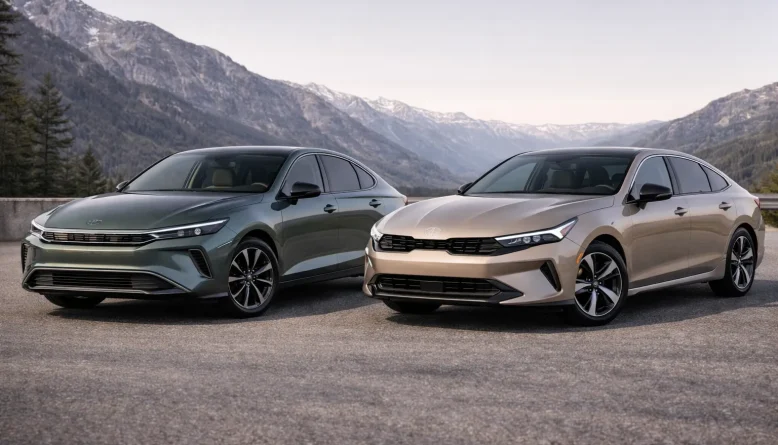
This 2025 Hyundai Sonata vs Kia K5 real-world test focuses on what actually matters once the showroom excitement fades: daily driving behavior, ownership value, and how these two closely related midsize sedans differ when used as primary transportation. For buyers cross-shopping the 2025 Hyundai Sonata vs Kia K5, the decision is less about headline specifications and more about character, usability, and long-term satisfaction. Both cars target the same segment and share corporate DNA, yet they approach the midsize sedan formula with noticeably different priorities that become clear only through real-world use.
Buyer Context and Market Positioning
The buyer considering a 2025 Hyundai Sonata vs Kia K5 is typically looking for a practical, efficient midsize sedan that balances comfort, technology, and cost of ownership without moving into luxury-brand pricing. This comparison matters because these two cars sit at the center of the non-luxury midsize sedan market, competing directly for buyers who may also be considering alternatives like the Toyota Camry or Honda Accord.
In real-world terms, the Sonata tends to attract buyers who prioritize interior space, comfort, and a slightly more conservative ownership experience. The K5, by contrast, often appeals to drivers who want similar practicality wrapped in a sportier design and a more engaged driving feel. When asking which should you buy between the Hyundai Sonata vs Kia K5, the answer depends less on raw capability and more on how each car aligns with daily habits and long-term expectations.
Pricing, Trims, and Real-World Value
For the 2025 model year, both the Hyundai Sonata and Kia K5 are offered with a range of trims that broadly overlap in pricing, though exact MSRP figures and trim availability can vary by market and may change during the model year. In the U.S. market, both models typically start in the mid-$20,000 range and extend into the low-to-mid $30,000s when well equipped. If specific regional pricing is unavailable at the time of writing, buyers should verify current figures with local dealers.
In real-world purchasing scenarios, similarly priced Sonata and K5 trims often include comparable core features such as advanced driver-assistance systems, large infotainment displays, and modern connectivity. The Sonata frequently includes more comfort-oriented features as standard at a given price point, while the K5 may bundle sportier styling elements or optional performance-oriented packages that increase cost without necessarily improving daily usability. From a value perspective, the Sonata tends to emphasize content per dollar, whereas the K5 places more emphasis on visual appeal and brand differentiation.
Powertrain, Performance, and Efficiency
In everyday driving, the 2025 Hyundai Sonata vs Kia K5 comparison reveals subtle but meaningful differences in how powertrains are tuned. Both models are typically offered with naturally aspirated four-cylinder engines and available turbocharged options, paired with automatic transmissions. Exact output figures and fuel economy ratings depend on engine choice and drivetrain configuration, and buyers should consult official EPA or WLTP data where applicable.
On the road, the Sonata prioritizes smoothness and predictability. Acceleration is adequate for city traffic and highway merging, with transmission behavior tuned to minimize abrupt shifts. The K5, particularly in turbocharged form, feels more responsive off the line and during passing maneuvers, though this responsiveness can translate into slightly firmer throttle calibration in stop-and-go traffic. Efficiency in real-world mixed driving tends to be similar between the two, assuming comparable powertrains, with neither car clearly outperforming the other in everyday fuel costs based on available data.
Ride Quality, Handling, and Driving Character
Ride quality is one of the most noticeable distinctions in this 2025 Hyundai Sonata vs Kia K5 real-world test. The Sonata’s suspension tuning favors comfort, absorbing rough pavement and expansion joints with minimal intrusion into the cabin. This makes it particularly well suited for long commutes and highway cruising, where stability and low fatigue matter most.
The K5 adopts a firmer setup that delivers more immediate steering response and better body control during cornering. While this does not transform it into a sports sedan, it does feel more engaged on winding roads. The trade-off is that sharper impacts are more noticeable over broken surfaces. Buyers who value a relaxed driving experience may prefer the Sonata, while those who want a bit more feedback will likely gravitate toward the K5.
Interior Quality, Comfort, and Usability
Inside, both cabins reflect modern design priorities, though their execution differs. The Sonata’s interior emphasizes openness, with a layout that prioritizes visibility and ease of use. Materials quality is competitive for the segment, and seat comfort is well suited to extended driving. The driving position feels neutral and accommodating for a wide range of body types.
The K5’s interior design leans more aggressively toward the driver, with a cockpit-like feel and sport-inspired details. While material quality remains comparable, some controls are placed in a way that favors style over absolute intuitiveness. Cabin noise levels in both cars are well controlled at highway speeds, though the Sonata’s softer tuning contributes to a slightly calmer overall environment during long trips.
Infotainment, Technology, and Driver Assistance
Infotainment systems in both models are broadly similar in capability, offering large touchscreens, smartphone integration, and digital instrument clusters depending on trim. Responsiveness and screen clarity are generally strong in both vehicles, though user interface design differs.
In practice, the Sonata’s system prioritizes straightforward menus and minimal distraction, which benefits daily use. The K5’s interface offers more visual flair but can require additional attention to navigate while driving. Driver-assistance features such as adaptive cruise control and lane-keeping systems are available on both, and when properly calibrated, they function effectively in real-world traffic. As always, availability and standardization of these features vary by trim and market.
Space, Practicality, and Daily Use
For families or frequent passengers, space becomes a deciding factor in the Hyundai Sonata vs Kia K5 comparison. The Sonata generally offers slightly more rear-seat legroom and a more accommodating rear bench, which translates into better comfort for adult passengers and easier installation of child seats.
Cargo capacity is competitive in both sedans, with trunks that handle grocery runs and luggage without issue. The Sonata’s wider opening and flatter load floor make it marginally easier to use for bulky items. Storage solutions throughout the cabin are thoughtfully placed in both cars, though the Sonata again emphasizes convenience over style.
Safety and Reliability Considerations
Safety is a strong point for both vehicles, with a comprehensive suite of standard and available driver-assistance features. Crash-test ratings from recognized agencies should be consulted once finalized for the 2025 model year, as results may vary by market and configuration. If ratings are not yet published, buyers should verify them before making a decision.
Both brands offer competitive warranty coverage, which remains a significant advantage in this segment. Long-term reliability trends for Hyundai and Kia have improved over recent years, though buyers should rely on established data from trusted sources rather than assumptions, especially for newer powertrains or updated model years.
Ownership Costs and Long-Term Perspective
From an ownership cost standpoint, fuel expenses for the 2025 Hyundai Sonata vs Kia K5 are expected to be similar when equipped with comparable engines. Maintenance costs are also broadly aligned, supported by extensive dealer networks in North America and many global markets.
Depreciation trends can vary based on market perception and trim selection, and definitive data for the 2025 models may not yet be available. Historically, midsize sedans from both brands have depreciated at rates comparable to segment averages, making them reasonable long-term purchases rather than speculative investments.
Verdict: Which Buyer Should Choose Which Car
In this 2025 Hyundai Sonata vs Kia K5 real-world test, there is no single winner, only better alignment with specific ownership priorities. The Sonata is the stronger choice for buyers who value comfort, interior space, and a calm driving experience that supports long commutes and family use. It rewards owners who want a sedan that fades into the background of daily life in the best possible way.
The Kia K5, on the other hand, suits buyers who want their midsize sedan to feel a bit more distinctive and engaging without sacrificing practicality. Its firmer ride and sportier character make it more appealing to drivers who enjoy being involved in the driving process, even during routine trips.
Ultimately, deciding between the 2025 Hyundai Sonata vs Kia K5 comes down to how you define value in everyday ownership. Both are competent, well-rounded sedans, but their differences become meaningful only when viewed through the lens of real-world use rather than specifications alone.


No Responses Yet