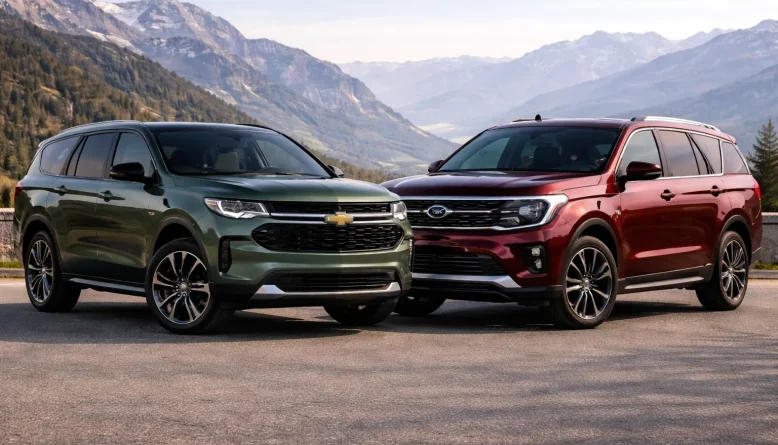
The 2025 Chevrolet Tahoe vs Ford Expedition review comes down to how two of the most capable full-size SUVs translate their size, power, and flexibility into everyday ownership. Buyers cross-shopping these vehicles already understand the trade-offs of body-on-frame SUVs and are now focused on ride quality, interior usability, long-term costs, and how each one fits family, towing, or work-related needs. This review examines where the Tahoe and Expedition differ in real-world use rather than where they overlap on paper.
Buyer Context and Market Positioning
Shoppers considering the 2025 Chevrolet Tahoe vs Ford Expedition typically need maximum space, strong towing capability, and the durability that comes with a truck-based platform. These buyers often tow boats or trailers, carry multiple passengers regularly, or live in regions where road conditions and weather demand more than a unibody crossover can offer.
Both vehicles sit squarely in the full-size SUV segment, competing directly with each other and with alternatives like the GMC Yukon and Toyota Sequoia. The Tahoe traditionally appeals to buyers who value ride comfort and interior configurability, while the Expedition often attracts those who prioritize straight-line performance and a more modern powertrain approach. When asking which should you buy in the Tahoe vs Expedition debate, usage patterns matter more than brand loyalty.
Pricing, Trims, and Real-World Value
For the 2025 model year, both the Tahoe and Expedition span wide pricing ranges depending on trim, drivetrain, and wheelbase. In the U.S. market, both generally start in the mid-$50,000 range and extend well into the $70,000s when fully equipped. Exact MSRP figures and trim availability can vary by region and should be verified locally, as manufacturers may adjust pricing during the model year.
In real-world value terms, the Tahoe offers a broader trim lineup with clearer steps between fleet-focused models and premium variants. The Expedition tends to bundle more performance-oriented features at higher trims, which can raise costs quickly. Value depends on whether buyers prioritize interior flexibility and comfort features or powertrain performance and towing confidence.
Powertrain, Performance, and Efficiency
The 2025 Chevrolet Tahoe vs Ford Expedition comparison highlights a key philosophical difference in powertrain strategy. The Tahoe offers multiple engine options, including naturally aspirated V8s and a diesel option in certain markets, paired with automatic transmissions and available four-wheel drive. This variety allows buyers to tailor the vehicle to towing, efficiency, or simplicity preferences.
The Expedition relies on a turbocharged V6 engine across its lineup, paired with an automatic transmission. In everyday driving, the Expedition feels quick and responsive, especially during highway merging and passing. Turbocharging delivers strong midrange torque, which suits towing and heavy loads.
Fuel economy depends heavily on configuration and use. Official EPA or regional ratings should be consulted for precise figures. In real-world driving, neither SUV is efficient by modern standards, though the Tahoe’s diesel option, where available, can significantly alter long-distance fuel consumption.
Ride Quality, Handling, and Driving Character
Ride quality is one of the most noticeable differences between these two. The Tahoe benefits from an independent rear suspension, which improves ride comfort and body control, particularly on rough pavement. It feels more composed over bumps and less unsettled when the cabin is fully loaded.
The Expedition uses a solid rear axle, which contributes to its towing stability and durability but can transmit more road imperfections into the cabin. On smooth highways, it feels stable and confident. In urban driving, the Tahoe’s suspension tuning makes it easier to live with day to day. Steering in both vehicles is light and predictable, though neither encourages aggressive driving.
Interior Quality, Comfort, and Usability
Interior design reflects each brand’s priorities. The Tahoe’s cabin emphasizes horizontal space and flexibility, with seating configurations that support passengers and cargo equally well. Material quality improves significantly in higher trims, and the driving position feels commanding without being truck-like.
The Expedition’s interior feels slightly more upright and performance-oriented. Seat comfort is strong in the first two rows, though third-row access and comfort depend on configuration. Over long trips, both vehicles provide adequate noise isolation, though the Tahoe’s independent suspension contributes to a calmer cabin over uneven surfaces.
Infotainment, Technology, and Driver Assistance
Both SUVs offer modern infotainment systems with large touchscreens, smartphone integration, and digital driver displays depending on trim. Responsiveness and screen clarity are competitive in both, though interface design differs.
Driver-assistance features such as adaptive cruise control, lane-keeping assistance, and blind-spot monitoring are widely available across both lineups. Standardization varies by trim and market, so buyers should confirm which features are included rather than optional. In real-world use, both systems function effectively but still require attentive drivers.
Space, Practicality, and Daily Use
Space is a shared strength, but execution differs. The Tahoe’s independent rear suspension allows for a lower cargo floor and more usable third-row space. This benefits families who regularly carry passengers and luggage together.
The Expedition offers excellent overall volume, especially in extended-wheelbase versions, though the higher cargo floor can affect ease of loading heavy items. Storage solutions are plentiful in both vehicles, and visibility is good for the class, though maneuvering in tight spaces remains challenging due to size alone.
Safety and Reliability Considerations
Both vehicles include comprehensive safety equipment and have historically performed well in crash testing. Buyers should consult the latest results for the 2025 model year once fully published, as ratings can vary by configuration and testing body.
Reliability expectations differ based on powertrain choice and usage. The Tahoe’s V8 engines have long service histories, while the Expedition’s turbocharged V6 emphasizes performance and efficiency. Long-term reliability data for the 2025 models is not yet complete, so buyers should rely on updated reports rather than assumptions.
Ownership Costs and Long-Term Perspective
Ownership costs for full-size SUVs are significant regardless of brand. Fuel costs are high relative to smaller vehicles, and maintenance expenses reflect size, complexity, and usage. The Tahoe’s diesel option, if chosen, can reduce fuel costs for high-mileage owners but may introduce higher service expenses.
Depreciation trends historically favor well-equipped trims of both models, though exact data for the 2025 versions is not yet established. Dealer network strength is a benefit for both Chevrolet and Ford in North America, supporting long-term ownership.
Verdict: Which Buyer Should Choose Which Car
The 2025 Chevrolet Tahoe vs Ford Expedition review does not identify a universal winner, but it does clarify buyer alignment. The Tahoe is better suited to buyers who prioritize ride comfort, interior flexibility, and a broader range of powertrain choices. It works well for families who use all three rows regularly and value a smoother daily driving experience.
The Expedition fits buyers who want strong acceleration, confident towing performance, and a more performance-oriented feel from a full-size SUV. It appeals to owners who regularly haul heavy loads and value turbocharged power delivery.
Both are capable, durable SUVs. The right choice depends on how often you tow, how you use interior space, and which driving characteristics matter most in everyday ownership.

No Responses Yet