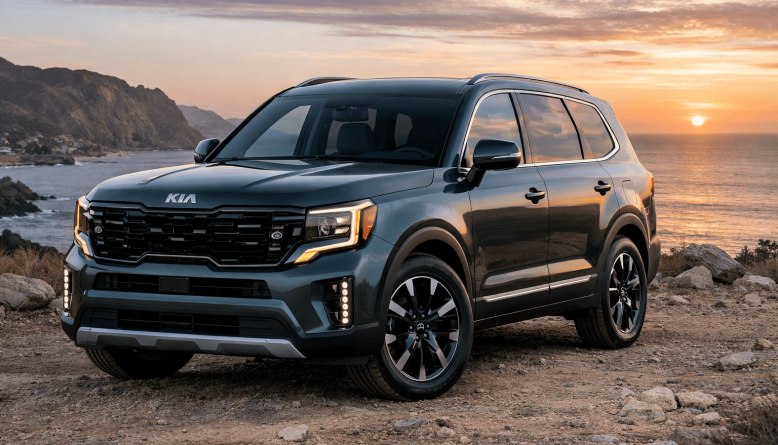
For buyers considering a three-row SUV today, the Telluride presents a familiar tension: strong design appeal and feature value versus long-term durability and mechanical simplicity. A discussion framed around the 2026 Kia Telluride inevitably reflects that dilemma, because many shoppers are cross-shopping it against the Toyota Grand Highlander, Honda Pilot, and Mazda CX-90 while weighing whether Kia’s steady cadence of updates enhances ownership confidence or adds complexity over time.
Market Position and Purpose
The Kia Telluride sits near the style- and value-led end of the midsize three-row SUV segment. From a product-planning perspective, its purpose is clear. It exists to offer near-premium design, generous standard features, and broad trim variety at prices that undercut luxury-brand alternatives. In ownership terms, the Telluride targets buyers who want their family vehicle to feel current and well-equipped without moving into luxury-brand pricing or maintenance structures.
What’s New
As of now, Kia has not released confirmed details outlining changes specific to the 2026 Telluride. The current generation received a substantial refresh for the 2023 model year, including exterior design revisions, interior updates, and expanded technology features, which have carried through subsequent model years. Any refreshed design, updated technology, or powertrain changes for 2026 remain unannounced, and no official specifications or equipment changes have been verified.
Exterior and Daily Usability
The Telluride’s exterior design emphasizes presence and visual width, which contributes to its popularity but also affects daily usability. Forward visibility remains good thanks to a relatively upright windshield, though thicker rear pillars reduce over-the-shoulder sightlines compared to boxier rivals. Wheel sizes increase significantly on higher trims, which enhances appearance but can introduce higher tire replacement costs. In daily use, the squared-off rear and wide tailgate make loading family gear straightforward despite the vehicle’s substantial footprint.
Real-World Driving Experience
In routine driving, the Telluride prioritizes calm, predictable behavior. Throttle response is tuned smoothly rather than aggressively, which suits traffic and urban driving. Steering effort is light and consistent, though feedback remains limited. Ride quality favors compliance over sharp control, absorbing broken pavement well but allowing modest body motion on uneven surfaces. Braking response is linear and confidence-inspiring in everyday conditions.
Performance in Everyday Conditions
Usable performance aligns with the Telluride’s family-focused mission. The naturally aspirated 3.8-liter V6, producing 291 horsepower in current verified specifications, delivers confident acceleration for merging and passing without feeling strained. Highway cruising remains relaxed, and the eight-speed automatic transmission shifts unobtrusively. While not designed for spirited driving, the Telluride performs its daily tasks with little effort.
Powertrain Behavior and Efficiency in Daily Use
Based on the latest confirmed EPA ratings, the Telluride returns approximately 20 mpg city and 26 mpg highway in front-wheel-drive form, with all-wheel-drive models rated slightly lower. In real-world ownership, combined fuel economy typically settles in the low-20 mpg range depending on load and driving style. Kia has not announced any hybrid, plug-in hybrid, or alternative powertrain for the 2026 Telluride, and no battery or charging specifications apply.
Interior Design and Ergonomics
Interior design remains one of the Telluride’s strongest ownership advantages. The cabin balances visual appeal with functional layout, offering clear sightlines and logically arranged controls. Seating comfort is strong in the first and second rows, with a usable third row for adults on shorter trips. Material quality improves noticeably on higher trims, though even base models feel thoughtfully finished for long-term use.
Infotainment and Software
Current Telluride models feature a dual-screen layout on upper trims, integrating infotainment and digital instrumentation. System responsiveness is competitive, menu structures are intuitive, and smartphone integration via Apple CarPlay and Android Auto is standard across most trims, though wireless availability varies by configuration. Long-term stability has generally been solid, though the system prioritizes features over minimalist simplicity.
Driver Assistance and Safety Behavior
Kia’s driver assistance systems are comprehensive and competitive within the segment. In real driving, adaptive cruise control and lane-centering functions operate smoothly, maintaining distance and lane position without abrupt corrections. The systems intervene confidently but not aggressively, which reduces fatigue on longer drives while preserving driver control.
Ride Comfort, Noise, and Long-Distance Use
On extended trips, the Telluride maintains a quiet and composed demeanor. Road noise is well suppressed on standard tires, though larger wheel packages introduce slightly more impact harshness on rough surfaces. Wind noise remains low at highway speeds, and seat cushioning supports long-distance comfort for most occupants. Overall fatigue levels remain low during sustained travel.
Ownership Costs and Practicality
Practicality plays a central role in the Telluride’s ownership appeal. Interior storage solutions are generous, cargo space is competitive with seats folded, and third-row access is straightforward. Maintenance costs align with mainstream midsize SUVs, though long-term ownership perceptions still trail brands like Toyota and Honda for some buyers. Warranty coverage remains a notable advantage in mitigating early ownership concerns.
Trims, Options, and Pricing
Verified trims for the current Telluride lineup include LX, S, EX, SX, SX Prestige, and X-Line and X-Pro variants depending on market. As of now, Kia has not released confirmed 2026 pricing or trim changes. For reference only, recent U.S. Telluride pricing has spanned from the mid-$30,000 range to the low-$50,000s, but all 2026 figures should be considered unconfirmed.
Release Timing
Kia has not announced official release timing for the 2026 Telluride. Historically, Telluride model years have launched in the U.S. market toward the end of the preceding calendar year, but no confirmed schedule has been published for this update cycle.
Comparison With Direct Competitors
In realistic cross-shopping scenarios, the Telluride competes most directly with the Honda Pilot, Toyota Grand Highlander, and Mazda CX-90. The Honda emphasizes mechanical simplicity and long-term familiarity. The Toyota offers hybrid efficiency and strong resale confidence. The Mazda focuses on driving engagement and interior refinement. The Telluride’s advantage lies in its blend of design, features, and value rather than in class-leading efficiency or performance.
Strengths, Weaknesses, and Trade-Offs
The Telluride’s strengths include interior design, feature content, ride comfort, and overall value perception. Its weaknesses center on average fuel efficiency and lingering questions around long-term durability compared to more conservative rivals. The trade-off for buyers is choosing visual appeal and technology richness over proven simplicity.
Conclusion and Buyer Guidance
The 2026 Kia Telluride will continue to appeal to families and daily drivers who want a three-row SUV that feels modern, comfortable, and well-equipped without entering luxury-brand pricing. It suits buyers who plan to lease or own within typical warranty periods and value design and features. Shoppers prioritizing maximum long-term reliability, hybrid efficiency, or minimalist interfaces may find better alignment elsewhere, but for balanced, feature-forward family use, the Telluride remains a compelling option.
No Responses Yet