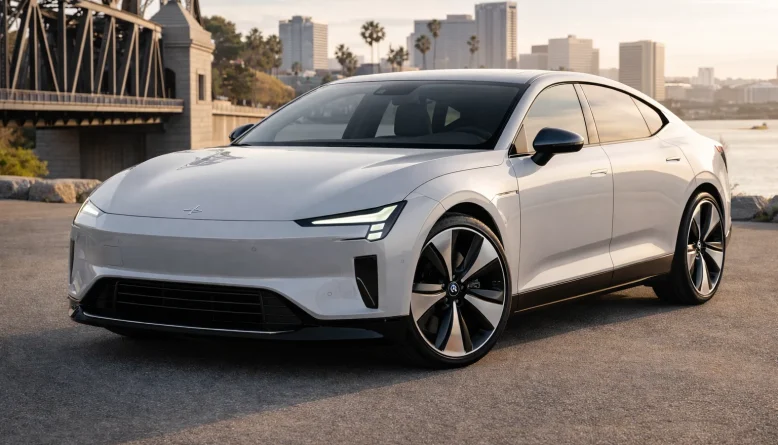
Every serious EV buyer eventually hits the same wall. The car looks right, the numbers look strong, but daily reality raises tougher questions. Will the range feel dependable in winter, will charging fit real routines, and will the ownership experience still feel solid once the novelty wears off? The 2026 polestar 4 enters the market right at that crossroads, targeting drivers who want something more distinctive than a Tesla but are unwilling to accept uncertainty as part of the deal.
Overview
The polestar 4 is positioned as a design-forward electric crossover coupe that leans heavily into identity as much as performance. It sits between traditional compact SUVs and low-slung EV sedans, aiming at buyers who want presence without bulk. The 2026 polestar 4 is less about chasing the longest range or quickest charge time and more about delivering a cohesive, premium-feeling EV ownership experience.
What’s New
For 2026, Polestar continues rolling out the model with incremental refinements rather than dramatic changes. Most updates focus on software calibration, feature availability, and market expansion rather than hardware revisions. That approach suggests Polestar is prioritizing stability and user feedback over constant reinvention, which matters for buyers wary of early-adopter risks.
Exterior
The exterior design is bold and unapologetic. The absence of a traditional rear window immediately sets the tone, replacing it with a camera-based rearview system. From some angles it looks sleek and futuristic, from others slightly unconventional. In daily use, the design draws attention without feeling gimmicky, though it does require an adjustment period for drivers used to traditional sightlines.
Interior
Inside, the cabin feels modern and deliberately minimalist. The seating position is low for a crossover, reinforcing the car’s coupe-like character. Front seats provide strong support for longer drives, while rear-seat space is adequate rather than generous. Cargo usability is respectable, though the sloping roofline imposes limits compared to boxier rivals.
Interior & Build Quality
Material quality aligns with premium expectations. Surfaces feel solid, and assembly quality is generally consistent. The interior prioritizes texture and design over excess padding, which gives it a clean, contemporary feel. Over rough pavement, the structure remains composed, reinforcing confidence in long-term durability.
Infotainment & Technology
The infotainment system centers around a large touchscreen running Google-based software. Navigation and voice control work well, though reliance on screen-based controls increases the learning curve. Over-the-air updates promise long-term improvement, but early ownership requires patience as drivers adapt to the interface philosophy.
Powertrain / Motor & Battery – 2026 polestar 4
The 2026 polestar 4 is offered with single- and dual-motor configurations paired to a large battery pack designed for competitive real-world range. Power delivery is smooth and immediate, with strong regenerative braking that becomes intuitive over time. The drivetrain feels refined rather than aggressive, prioritizing control over theatrics.
Performance
Acceleration is brisk without feeling excessive. Dual-motor versions deliver confident passing power, while single-motor variants favor efficiency and balance. The low center of gravity contributes to stable handling, though ride quality remains tuned more toward firmness than plush comfort. It feels composed on highways and confident through sweeping corners.
Efficiency / Range – 2026 polestar 4
Real-world range behavior is consistent when driven with restraint. City efficiency benefits from strong regeneration, while highway range depends heavily on speed discipline. In mixed driving, the range feels usable rather than anxiety-inducing, though cold weather will reduce expectations. It rewards planning rather than spontaneity.
Charging & Real-World Use – 2026 polestar 4
Charging performance is competitive, with fast-charging capability that supports road trips when infrastructure cooperates. The charging curve tapers predictably, favoring shorter, frequent stops over deep sessions. Home charging remains the most seamless ownership scenario, while reliance on public chargers requires patience and planning, especially during peak travel times.
Safety
Safety performance meets premium EV expectations. Structural rigidity and low center of gravity contribute to stable emergency handling. Polestar’s safety philosophy emphasizes predictability, which translates into calm responses during sudden maneuvers rather than dramatic intervention.
Driver Assistance
Driver assistance systems operate smoothly but conservatively. Adaptive cruise control and lane-centering function well on highways, reducing fatigue without constant corrections. These systems feel supportive rather than intrusive, though they do not lead the segment in autonomy ambition.
Trims, Options & Pricing
Official pricing varies by market and configuration, with the polestar 4 positioned firmly in the premium EV space. Options focus more on performance and design themes than luxury excess. Buyers should expect pricing that reflects exclusivity rather than value leadership.
Release Date
Polestar has not confirmed a specific on-sale date for all markets. According to manufacturer guidance and widely reported sources, the polestar 4 is expected to arrive later in 2025 or in early 2026 depending on region. Availability may vary by configuration and market rollout pace.
Key Pros & Cons
The design stands out in a crowded EV market. Performance feels controlled and confident. Interior quality supports premium expectations. Software updates promise long-term improvement. Charging speeds are competitive for road trips. Daily driving feels refined and predictable.
Rear visibility relies entirely on cameras. Ride comfort leans firm on rough roads. Rear-seat space trails some rivals. Public charging dependence requires planning. Interface learning curve can frustrate new owners. Resale confidence remains unproven compared to established brands.
Competitors / Rivals
The polestar 4 competes with vehicles like the Tesla Model Y, Ford Mustang Mach-E, BMW iX2, and Audi Q4 e-tron. Tesla emphasizes charging convenience and software maturity. Ford offers familiarity and performance variants. German rivals focus on brand heritage. The Polestar differentiates itself through design and restrained performance character.
Final Verdict
The 2026 polestar 4 is not the safest EV choice, nor the easiest. It is, however, one of the most distinctive. For buyers who value design, controlled performance, and a curated ownership experience over raw numbers, it delivers a compelling alternative. It demands engagement and adaptation, but for the right owner, that trade feels intentional rather than inconvenient.

No Responses Yet