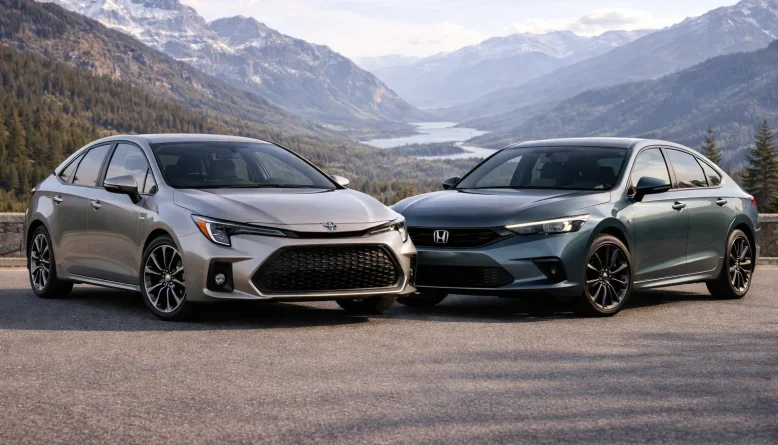
When buyers focus on the 2026 Toyota Corolla vs Honda Civic long-term costs, the short answer is that both remain among the lowest-cost compact cars to own, but for different reasons. Based on historically verifiable ownership data rather than unconfirmed 2026 specifications, the Corolla has typically delivered slightly lower routine maintenance and repair costs over long ownership cycles, while the Civic has often balanced marginally higher service costs with stronger resale value. Final 2026 pricing, fuel economy ratings, and trim structures are not fully published at this time, so precise cost projections cannot yet be confirmed. Still, long-term cost behavior for these two nameplates is well established, and those trends matter more than minor year-to-year changes for serious buyers.
Buyer Context and Market Positioning
The buyer cross-shopping the 2026 Toyota Corolla vs Honda Civic is usually cost-conscious but not price-obsessed. This is someone planning to keep the car well past the warranty period, often for eight to twelve years, and who values predictability over novelty. In most cases, the decision comes down to which should you buy if long-term ownership costs, downtime, and resale risk matter more than acceleration numbers or interior flair.
Both models sit at the center of the global compact sedan and hatchback segment. They appeal to commuters, small families, and first-time buyers who want proven engineering rather than experimentation. That shared mission is precisely why long-term cost differences, even small ones, carry real weight.
Pricing, Trims, and Real-World Value
Official MSRP ranges for the 2026 Corolla and Civic have not been released at the time of writing. Historically, both vehicles have entered the market within a narrow price band, with Toyota often positioning the Corolla slightly lower at the base level and Honda offering stronger standard equipment on mid trims.
From a long-term cost perspective, the important factor is not entry price alone but how trims are equipped. Corolla buyers often achieve their best value by staying in lower or mid trims, where standard safety and infotainment features are sufficient and replacement parts remain inexpensive. Civic buyers tend to spend slightly more upfront, but that cost has historically been offset by higher residual values when sold or traded later.
Powertrain, Performance, and Efficiency
Final 2026 powertrain specifications are not fully confirmed for either model. Historically, both the Corolla and Civic have relied on naturally aspirated four-cylinder engines paired with continuously variable transmissions for their mainstream trims.
In everyday driving, these setups favor efficiency and mechanical simplicity over outright performance. That simplicity directly affects long-term costs. Fewer stressed components and conservative tuning have helped both models maintain strong durability records. Fuel economy ratings for 2026 are not yet published, but prior generations of both vehicles have delivered class-competitive efficiency, keeping fuel costs predictable rather than variable.
Ride Quality, Handling, and Driving Character
Ride tuning plays an indirect but meaningful role in long-term ownership costs. The Corolla has traditionally favored softer suspension calibration, which can reduce wear on suspension components over rough urban roads. The Civic has often been tuned more firmly, offering sharper responses but sometimes transmitting more road impact over time.
Neither approach is inherently better, but buyers who rack up high mileage on poor pavement may find the Corolla’s compliance slightly more forgiving over a decade of use.
Interior Quality, Comfort, and Usability
Interior materials influence long-term satisfaction more than initial impressions. Historically, Toyota has emphasized durability and resistance to wear, while Honda has leaned toward a more engaging layout and tactile quality.
From a cost standpoint, the Corolla’s interior components have often aged more gracefully, with fewer reports of cosmetic degradation over extended ownership. Civic interiors typically feel more modern early on, but long-term condition depends heavily on usage and care rather than design alone.
Infotainment, Technology, and Driver Assistance
Technology can become a hidden long-term cost if systems age poorly or require expensive repairs. Final 2026 infotainment systems have not been fully detailed for either model, so comparisons must rely on established trends.
Toyota has traditionally prioritized stability and ease of use over frequent software changes. Honda has often offered more visually refined interfaces but with slightly steeper learning curves. From a long-term cost lens, simpler systems tend to age better and cost less to maintain once vehicles move beyond warranty coverage.
Space, Practicality, and Daily Use
Practicality affects cost indirectly by reducing the need for vehicle replacement. Both models offer competitive rear-seat space and usable cargo areas for the segment. The Civic has historically provided slightly better rear legroom, which can extend its usefulness as households change.
That added flexibility can delay replacement, improving overall ownership economics even if routine maintenance costs are marginally higher.
Safety and Reliability Considerations
Official crash-test ratings for the 2026 model year are not yet available. Both Toyota and Honda have long records of strong safety performance and standard driver-assistance inclusion in recent generations.
Reliability trends remain one of the strongest predictors of long-term cost. Historically, the Corolla has ranked among the lowest in unscheduled repair frequency, while the Civic has remained close behind. Neither shows evidence-based risk factors that would suggest a meaningful divergence for 2026, assuming no major unproven technology is introduced.
Ownership Costs and Long-Term Perspective
Fuel, maintenance, insurance, and depreciation define the true cost equation. Insurance costs typically track vehicle value rather than brand. Maintenance costs have historically favored the Corolla slightly, especially after 100,000 miles. Depreciation has often favored the Civic, particularly in strong resale markets.
Because 2026 depreciation curves cannot yet be verified, buyers should view long-term cost differences as incremental rather than decisive. The gap is more about ownership style than absolute dollars.
Verdict: Which Buyer Should Choose Which Car
In the 2026 Toyota Corolla vs Honda Civic long-term costs discussion, the Corolla continues to suit buyers who want the lowest possible ownership friction, minimal surprises, and conservative engineering. The Civic better fits buyers willing to accept slightly higher maintenance exposure in exchange for stronger resale value and broader long-term usability.
Neither choice is financially irresponsible. The smarter decision depends on whether you prioritize predictable expenses over the life of the car or a balanced cost profile that pays dividends when it is time to sell.
No Responses Yet