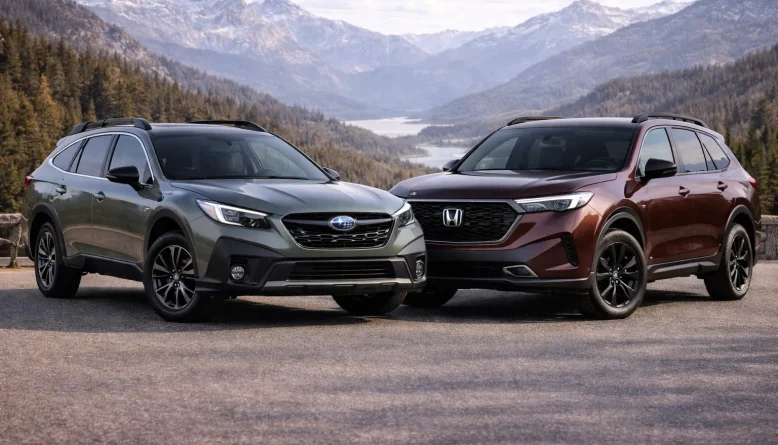
The short answer in this 2026 Subaru Outback vs Honda Passport comparison is that these two vehicles target buyers with overlapping needs but solve them in very different ways. As of now, complete 2026 specifications, pricing, and official fuel economy ratings for both models have not been fully released. Even so, long-standing design priorities, drivetrain strategies, and ownership patterns make it possible to assess how each vehicle is likely to perform in real-world use. For buyers already cross-shopping these two, the choice is less about brand loyalty and more about whether everyday efficiency or size and strength better match long-term ownership needs.
Buyer Context and Market Positioning
The buyer comparing a 2026 Subaru Outback vs Honda Passport is usually looking beyond traditional compact crossovers. This buyer wants more capability, more space, and more confidence in bad weather or light off-road use, without stepping into a full-size SUV. The comparison matters because these vehicles sit at the edge of different segments while often landing at similar price points.
The Outback occupies a unique space between wagon and crossover, appealing to buyers who value a lower ride height, standard all-wheel drive, and car-like road manners. The Passport positions itself as a more traditional midsize SUV, emphasizing width, power, and interior volume. When asking which should you buy, the decision usually hinges on driving environment, cargo needs, and tolerance for fuel and ownership costs.
Pricing, Trims, and Real-World Value
Official 2026 MSRP ranges have not yet been confirmed for either vehicle. Historically, the Subaru Outback has offered a narrower trim range with strong standard equipment, including all-wheel drive across the lineup. This approach often allows buyers to achieve their desired configuration without climbing far up the trim ladder.
The Honda Passport has traditionally entered at a higher base price but offers more interior space and a stronger standard engine. Real-world value depends on usage. Buyers who need capability but not size often find the Outback more cost-efficient over time, while those who value space and power may justify the Passport’s higher entry point.
Powertrain, Performance, and Efficiency
Final 2026 powertrain details remain unconfirmed. Historically, the Outback has relied on four-cylinder engines paired with continuously variable transmissions, prioritizing smoothness and fuel efficiency in daily driving. Power delivery tends to be linear and predictable, which suits commuting and long-distance travel.
The Passport has traditionally featured a larger-displacement engine with a conventional automatic transmission, delivering stronger acceleration and passing performance. That advantage becomes noticeable during highway merging and when carrying heavy loads. Fuel economy ratings for 2026 are not yet available, but prior generations have shown the Outback delivering better efficiency, especially in mixed driving.
Ride Quality, Handling, and Driving Character
Driving character represents a clear divergence. The Outback’s lower center of gravity and suspension tuning have historically produced a composed, car-like feel on highways and winding roads. Steering response is typically light but precise, contributing to low driver fatigue over long trips.
The Passport feels larger and more upright. Its suspension tuning prioritizes stability and comfort over sharp responses. On rough pavement, the Passport often absorbs impacts well, but its size becomes more apparent in tight urban settings. Buyers should consider how often they drive in cities versus open highways or rural areas.
Interior Quality, Comfort, and Usability
Interior execution reflects each vehicle’s mission. Subaru interiors have traditionally emphasized durability, visibility, and straightforward controls. Materials focus on long-term wear rather than visual drama, which appeals to owners planning extended ownership.
Honda’s Passport interior generally feels more spacious and substantial, with wider seats and greater shoulder room. Control layouts are intuitive, though the cabin’s larger dimensions can make it feel less intimate. Long-term livability depends on whether the buyer values openness and space over compact efficiency.
Infotainment, Technology, and Driver Assistance
Infotainment and driver-assistance details for 2026 have not been fully published. Historically, Subaru has favored conservative software updates, prioritizing stability and ease of use. Honda has emphasized responsiveness and logical menu structures.
From an ownership perspective, both brands have strong reputations for usable driver-assistance systems. The deciding factor often becomes how seamlessly those systems integrate into daily driving rather than how advanced they appear on paper.
Space, Practicality, and Daily Use
Practicality is where the Passport clearly differentiates itself. It offers more rear-seat space, a wider cargo area, and easier accommodation for bulky items. This benefits families, pet owners, and buyers who frequently carry gear.
The Outback counters with a lower load floor and easier reach into the cargo area. For buyers who load and unload frequently, that design can reduce strain and improve daily convenience. Child-seat access and rear-seat comfort are adequate in both, but space-hungry households may lean toward the Honda.
Safety and Reliability Considerations
Crash-test ratings for the 2026 model year are not yet available. Both Subaru and Honda have strong safety reputations and typically include comprehensive active safety systems as standard.
Reliability trends favor both brands, though Subaru’s all-wheel-drive systems require consistent maintenance to perform optimally long term. Honda’s powertrains have historically demonstrated strong durability, particularly in higher-displacement applications. There is no evidence-based data suggesting a major shift for either model in 2026.
Ownership Costs and Long-Term Perspective
Fuel costs are likely to favor the Outback based on historical efficiency, though official 2026 ratings are pending. Maintenance costs for both vehicles have traditionally remained reasonable within their segments.
Depreciation trends have favored Subaru in regions where all-wheel drive is highly valued, while Honda’s broader market appeal supports steady resale values. Ownership costs ultimately depend on mileage, usage, and how long the vehicle is kept.
Verdict: Which Buyer Should Choose Which Car
In this 2026 Subaru Outback vs Honda Passport comparison, the Outback is best suited to buyers who prioritize efficiency, all-weather confidence, and car-like driving behavior over sheer size. The Passport fits buyers who need more space, stronger acceleration, and a traditional SUV feel, even if that comes with higher fuel and ownership costs.
Neither vehicle is the correct choice for every buyer. The better decision depends on how the vehicle will be used day to day and which compromises matter least over years of ownership.


No Responses Yet