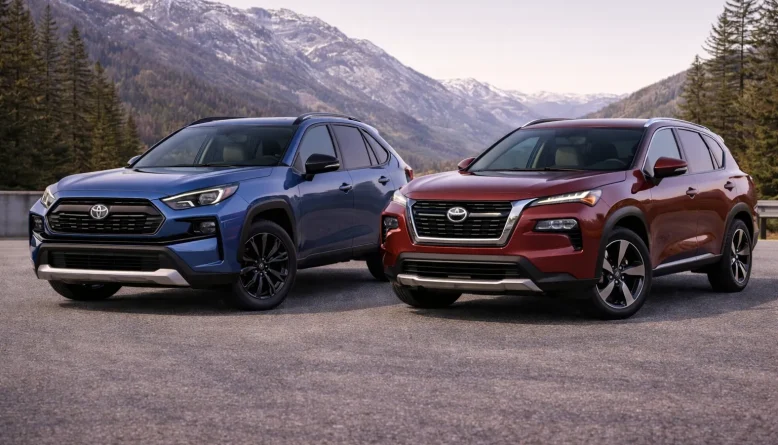
The direct answer in this 2026 Toyota RAV4 vs Nissan Rogue comparison is that the RAV4 continues to prioritize long-term durability and predictable ownership costs, while the Rogue focuses more on ride comfort, interior presentation, and everyday ease of use. As of now, full and final 2026 specifications, pricing, and EPA fuel economy ratings for both vehicles have not been completely released. Even so, each model’s established engineering approach and ownership history provide meaningful insight for buyers already cross-shopping these two compact crossovers.
Buyer Context and Market Positioning
The buyer considering a 2026 Toyota RAV4 vs Nissan Rogue is usually shopping at the center of the compact SUV market. This is a practical buyer who needs a vehicle for commuting, family duty, and occasional road trips, often with long-term ownership in mind. The comparison matters because these two models appeal to similar budgets but differ in how they balance reliability, comfort, and driving character.
The RAV4 has long positioned itself as a durable, no-nonsense choice with broad market appeal and strong resale strength. The Rogue aims to differentiate through comfort-focused tuning and a more upscale interior feel. When asking which should you buy, the real decision often centers on whether long-term predictability or daily refinement matters more.
Pricing, Trims, and Real-World Value
Official 2026 MSRP ranges have not yet been confirmed for either vehicle. Historically, the Toyota RAV4 has offered a wide trim range, allowing buyers to scale from basic transportation to more feature-rich configurations without changing models. That flexibility often helps buyers align spending closely with actual needs.
The Nissan Rogue has typically entered the market at a competitive base price while emphasizing strong standard equipment, particularly in safety and interior features. In real-world terms, RAV4 buyers often benefit from stronger resale value, while Rogue buyers may feel they get more visible features for the money at the time of purchase.
Powertrain, Performance, and Efficiency
Finalized 2026 powertrain details remain unconfirmed. Historically, the RAV4 has relied on proven four-cylinder engines paired with conventional automatic or continuously variable transmissions, emphasizing durability and consistent performance. Throttle response tends to be predictable rather than aggressive, which suits daily driving.
The Rogue has historically focused on smoothness and low-speed responsiveness, particularly in city traffic. Acceleration is adequate for merging and passing, though not performance-oriented. Fuel economy ratings for 2026 are not yet available, but prior generations have shown both vehicles delivering competitive efficiency within the segment, with differences that are usually marginal in real-world use.
Ride Quality, Handling, and Driving Character
Ride quality is one of the clearer distinctions. The Rogue has typically been tuned for comfort, with suspension calibration that softens rough pavement and reduces cabin disturbance. This character benefits daily commuting and longer drives.
The RAV4 feels firmer and more utilitarian. Steering response is direct, and body control prioritizes stability over plushness. Buyers who value a planted, predictable feel may prefer this approach, while those sensitive to ride comfort may lean toward the Rogue.
Interior Quality, Comfort, and Usability
Interior design reflects each vehicle’s priorities. The RAV4’s cabin has traditionally emphasized durability and ease of cleaning, with materials chosen for longevity rather than visual flair. Controls are straightforward and easy to learn.
The Rogue’s interior generally feels more modern and upscale, with softer materials and a calmer visual presentation. Seat comfort has often been a Rogue strength, particularly on longer drives. Long-term satisfaction depends on whether the buyer values tactile comfort or proven durability more highly.
Infotainment, Technology, and Driver Assistance
Infotainment and driver-assistance details for 2026 have not been fully released. Historically, Toyota has favored conservative system updates, prioritizing reliability and consistent behavior over frequent changes. Nissan has emphasized interface clarity and ease of use, often with larger displays and intuitive menus.
In everyday ownership, both systems generally perform well. Differences become more noticeable over time, where simpler systems tend to age more gracefully and require fewer updates or repairs.
Space, Practicality, and Daily Use
Both vehicles offer competitive rear-seat space and cargo capacity for the segment. The RAV4’s cargo area tends to be more squared-off, which helps when loading bulky items. The Rogue’s interior packaging often feels more open and passenger-friendly, particularly for rear-seat occupants.
Child-seat installation, door opening angles, and storage solutions are practical in both. Daily usability differences usually come down to interior layout preference rather than objective space limitations.
Safety and Reliability Considerations
Crash-test ratings for the 2026 model year are not yet available. Both Toyota and Nissan have strong safety records and typically include a comprehensive set of standard driver-assistance features.
Reliability trends remain a key differentiator. Toyota has a long-standing reputation for long-term dependability, which directly influences ownership costs and resale value. Nissan reliability has improved over time, though long-term perceptions still vary more by model year and powertrain. There is no confirmed evidence suggesting a major shift for 2026 in either direction.
Ownership Costs and Long-Term Perspective
Fuel costs are likely to be similar between the two based on historical efficiency. Maintenance and repair costs have traditionally favored the RAV4, particularly as mileage increases. Depreciation has also tended to favor Toyota, especially in markets where brand trust strongly influences used-car demand.
The Rogue can still represent good value for buyers who prioritize comfort and plan shorter ownership cycles. For long-term owners, predictability often weighs more heavily than initial impressions.
Verdict: Which Buyer Should Choose Which Car
In this 2026 Toyota RAV4 vs Nissan Rogue comparison, the RAV4 is better suited to buyers who prioritize long-term reliability, resale value, and a durable ownership experience. The Rogue fits buyers who value ride comfort, interior refinement, and a more relaxed daily driving experience, even if long-term costs may be less predictable.
Neither vehicle is the correct answer for every buyer. The better choice depends on how long you plan to keep the vehicle and whether your priorities center on ownership stability or everyday comfort.

No Responses Yet