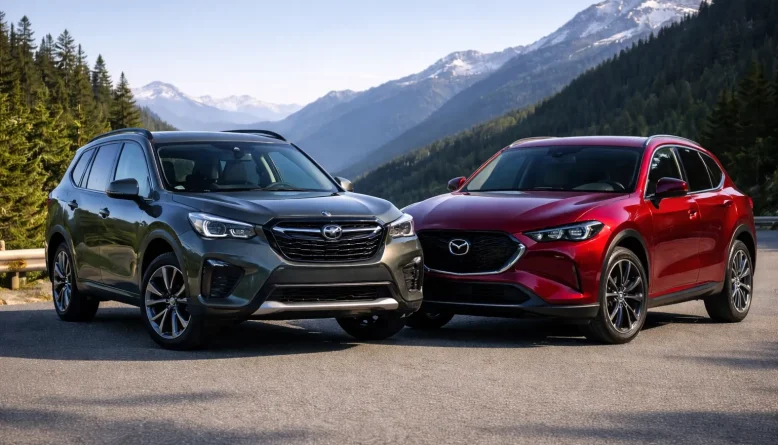
A 2024 Subaru Forester vs Mazda CX-5 ownership comparison centers on how these compact SUVs fit into daily life over several years, not how they look on paper. Both appeal to practical buyers, yet they approach ownership from different angles. The Forester emphasizes visibility, standard all-wheel drive, and long-term ease of use, while the CX-5 focuses on driving refinement, interior quality, and a more premium road feel. For buyers cross-shopping these two, the real decision comes down to lifestyle priorities rather than headline features.
Buyer Context and Market Positioning
The buyer comparing a 2024 Subaru Forester vs Mazda CX-5 is usually shopping in the heart of the compact SUV segment. This is a crowded category, but these two models stand out because they attract buyers who want something more deliberate than a basic appliance vehicle.
The Subaru Forester traditionally appeals to buyers who value practicality, outdoor usability, and confidence in poor weather. Standard all-wheel drive across the lineup reinforces that positioning. The Mazda CX-5, by contrast, targets buyers who want a compact SUV that feels closer to a premium crossover in design and driving manners.
When shoppers ask “Subaru Forester vs Mazda CX-5, which should you buy,” they are often deciding whether function or refinement matters more in everyday ownership.
Pricing, Trims, and Real-World Value
Pricing for both vehicles sits squarely in the mainstream compact SUV range, though they structure value differently. The 2024 Subaru Forester lineup is straightforward, with standard all-wheel drive on every trim and relatively modest jumps between trim levels. Many commonly purchased Forester trims already include safety technology and practical features without heavy reliance on option packages.
The Mazda CX-5 also offers multiple trims, including higher-end variants that push the vehicle closer to entry-luxury pricing. All-wheel drive is available but not always standard, depending on market and trim. As a result, similarly priced CX-5 and Forester models may differ significantly in equipment focus rather than overall content.
From an ownership perspective, the Forester often feels easier to spec logically, while the CX-5 allows buyers to pay more for enhanced materials and design.
Powertrain, Performance, and Efficiency
Powertrain choices highlight a philosophical split in the 2024 Subaru Forester vs Mazda CX-5 ownership discussion. The Forester uses a naturally aspirated four-cylinder engine paired with a continuously variable transmission and standard all-wheel drive. Power delivery is smooth and predictable, favoring steady progress over quick acceleration.
The Mazda CX-5 offers more variety depending on market, including a naturally aspirated four-cylinder and, in some regions, an available turbocharged option. Transmissions are traditional automatics, which some buyers prefer for their familiar feel.
Fuel economy ratings vary by drivetrain and market, and buyers should consult official EPA or WLTP figures. In real-world use, both vehicles prioritize efficiency over performance, though the CX-5 can feel more responsive in daily driving.
Ride Quality, Handling, and Driving Character
On the road, the Subaru Forester prioritizes comfort and confidence. Suspension tuning absorbs rough pavement well, and the vehicle remains stable on uneven surfaces. Steering is light, and body movements are controlled but not sporty.
The Mazda CX-5 delivers a noticeably different experience. Steering response feels sharper, and the chassis communicates more clearly through corners. Ride quality remains composed, but the tuning favors engagement rather than isolation.
Over long-term ownership, Forester drivers often appreciate how little effort the vehicle demands, while CX-5 owners tend to value how it feels during every commute.
Interior Quality, Comfort, and Usability
Interior design reinforces each vehicle’s mission. The Subaru Forester cabin emphasizes visibility, upright seating, and simple controls. Materials prioritize durability over visual flair, and outward sightlines remain among the best in the segment.
The Mazda CX-5 interior feels more refined, with higher-quality materials and a cohesive design language. Seating position is slightly lower, contributing to a more car-like feel, though rear visibility is not as expansive as in the Forester.
For ownership, the Forester excels in ease of use and comfort over long hours, while the CX-5 appeals to buyers who value tactile quality and design consistency.
Infotainment, Technology, and Driver Assistance
Both vehicles offer modern infotainment systems with smartphone integration, though execution differs. Subaru’s system focuses on straightforward operation, while Mazda’s interface emphasizes minimal distraction through a rotary controller rather than touch input in some configurations.
Driver-assistance features such as adaptive cruise control, lane-keeping assistance, and automatic emergency braking are widely available on both models. Subaru’s EyeSight system is standard on most trims, which simplifies ownership decisions. Mazda includes similar technology, though availability can depend on trim level and market.
In daily use, both systems perform reliably, with differences largely coming down to interface preference.
Space, Practicality, and Daily Use
Practicality strongly favors the Subaru Forester. Its boxier shape translates into generous headroom, an airy cabin, and a wide cargo opening. Rear-seat access is easy, and child-seat installation benefits from the upright design.
The Mazda CX-5 offers competitive cargo space for the segment but prioritizes style over maximum volume. Rear-seat space is adequate for adults, though it feels tighter than the Forester in daily family use.
For buyers whose routines involve gear, pets, or frequent passengers, the Forester’s layout often proves more accommodating.
Safety and Reliability Considerations
Both the Forester and CX-5 have earned strong safety reputations, supported by available crash-test ratings from recognized agencies where applicable. Standard safety equipment is comprehensive, particularly on the Forester.
Reliability trends favor conservative engineering. Subaru’s naturally aspirated engine and long-standing all-wheel-drive system appeal to buyers seeking predictability. Mazda’s recent reliability record has been strong, especially as the brand has reduced complexity in its powertrain offerings.
Warranty coverage follows industry norms and should be confirmed by region.
Ownership Costs and Long-Term Perspective
Ownership costs extend beyond fuel. The Forester’s simpler powertrain and standard all-wheel drive contribute to predictable maintenance expectations. Fuel costs remain reasonable, though not class-leading.
The Mazda CX-5 may cost slightly more to maintain depending on configuration, particularly for higher trims. Depreciation trends vary by market, though both vehicles maintain solid resale value within the segment.
Dealer experience and brand support can influence satisfaction, especially for long-term owners.
Verdict: Which Buyer Should Choose Which Car
In a 2024 Subaru Forester vs Mazda CX-5 ownership comparison, the right choice depends on how you use your vehicle every day. Buyers who prioritize visibility, space, standard all-wheel drive, and long-term practicality will likely find the Forester better aligned with their needs.
The Mazda CX-5 suits buyers who want a compact SUV that feels refined and engaging without stepping into a luxury brand. It rewards those who care about design and driving feel.
Neither is universally better. The best choice reflects whether your ownership priorities lean toward function or finesse, a distinction that becomes clearer the longer you live with the vehicle.
No Responses Yet