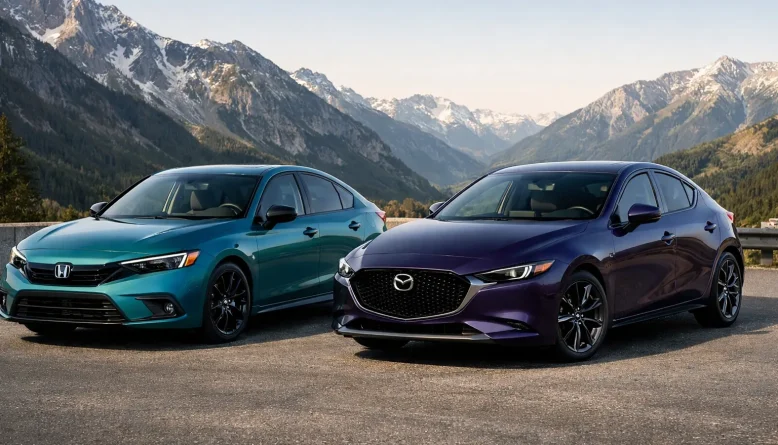
A 2024 Honda Civic vs Mazda 3 sedan comparison is ultimately about choosing between two compact sedans that deliver value in very different ownership-focused ways. The Civic emphasizes space efficiency, fuel economy, and long-term dependability, while the Mazda 3 sedan prioritizes design quality, driving feel, and a more premium ownership experience at a similar price point. For buyers cross-shopping these cars, the decision is less about basic transportation and more about how daily driving, maintenance, and usability align with personal priorities over several years.
Buyer Context and Market Positioning
Buyers considering a 2024 Honda Civic vs Mazda 3 sedan typically want a compact sedan that balances cost control with refinement. This segment attracts commuters, first-time buyers, and downsizers who still care about comfort, technology, and resale value.
The Honda Civic sits at the center of the compact sedan market and appeals to buyers who value proven reliability, strong resale, and broad usability. It functions as a rational default choice. The Mazda 3 sedan targets a narrower audience, often buyers who want something more distinctive in design and driving character without stepping into a luxury brand.
When shoppers ask which should you buy, they are often deciding whether long-term practicality or driving enjoyment matters more in everyday ownership.
Pricing, Trims, and Real-World Value
Pricing for the 2024 Honda Civic sedan generally starts lower than the Mazda 3 sedan, depending on market and trim. Honda offers a relatively simple trim structure, with most buyers gravitating toward mid-level trims that balance price and features.
The Mazda 3 sedan often carries a slightly higher starting price, particularly when equipped with all-wheel drive, which is available in some markets. Mazda’s trim strategy bundles features more aggressively, meaning higher trims add noticeable interior and technology upgrades.
In real-world value terms, the Civic often delivers more space and efficiency per dollar, while the Mazda 3 asks buyers to pay slightly more for perceived quality and refinement.
Powertrain, Performance, and Efficiency
Powertrain offerings highlight a clear contrast in philosophy. The 2024 Honda Civic sedan uses a naturally aspirated four-cylinder engine as standard, paired with a continuously variable transmission. Power delivery is smooth and predictable, favoring efficiency and low operating stress over outright performance.
The Mazda 3 sedan relies on a naturally aspirated four-cylinder engine paired with a conventional automatic transmission. In some markets, an available turbocharged engine adds performance but also increases cost and complexity. Front-wheel drive is standard, with all-wheel drive available in certain regions.
Fuel economy ratings vary by configuration and market, and buyers should consult official EPA or WLTP figures. In daily use, the Civic generally delivers stronger efficiency, especially in mixed city and highway driving.
Ride Quality, Handling, and Driving Character
On the road, the Honda Civic prioritizes balance and comfort. Suspension tuning absorbs rough pavement well, and the car remains stable at highway speeds. Steering is light and predictable, which suits daily commuting and long drives.
The Mazda 3 sedan delivers a firmer, more controlled driving feel. Steering response is more direct, and body control feels tighter through corners. Ride quality remains composed but communicates more of the road surface.
Over long-term ownership, Civic drivers often appreciate how easy the car is to live with, while Mazda 3 owners tend to value the added engagement during routine driving.
Interior Quality, Comfort, and Usability
Interior execution reflects each brand’s priorities. The Honda Civic cabin emphasizes simplicity, visibility, and ergonomics. Materials are durable rather than luxurious, and controls are intuitive, contributing to low-friction daily use.
The Mazda 3 sedan interior feels more upscale, with higher-quality materials and a cohesive design language. Seating position is lower and more car-like, which enhances the driving experience but slightly reduces outward visibility.
From an ownership perspective, the Civic excels in long-term usability and space efficiency, while the Mazda 3 appeals to buyers who value interior ambiance and tactile quality.
Infotainment, Technology, and Driver Assistance
Both sedans offer modern infotainment systems with smartphone integration. Honda’s system emphasizes ease of use and quick learning, while Mazda’s interface favors minimal distraction through a rotary controller rather than touchscreen input in some configurations.
Driver-assistance features such as adaptive cruise control, lane-keeping assistance, and automatic emergency braking are widely available. Honda includes many of these features as standard on most trims, which simplifies ownership decisions. Mazda offers similar technology, though availability can depend on trim and market.
In daily driving, both systems perform reliably, with differences largely coming down to interface preference.
Space, Practicality, and Daily Use
Practicality strongly favors the Honda Civic. Rear-seat legroom and headroom exceed those of the Mazda 3 sedan, and the trunk offers more usable space for everyday needs. Entry and exit are easier, particularly for rear passengers.
The Mazda 3 sedan provides adequate space for daily use but prioritizes design over maximum interior volume. Rear-seat space feels tighter, which can matter for families or frequent passengers.
For ownership scenarios involving commuting, carpooling, or travel, the Civic’s space advantage becomes noticeable over time.
Safety and Reliability Considerations
Both vehicles have strong safety credentials, supported by available crash-test ratings from recognized agencies where applicable. Standard safety equipment is comprehensive on both models, particularly in North American markets.
Reliability trends favor conservative engineering. The Honda Civic benefits from a long-standing reputation for durability and predictable ownership costs. Mazda’s recent reliability record has been strong as well, especially with its naturally aspirated engines and reduced drivetrain complexity.
Warranty coverage aligns with segment norms and should be verified by region.
Ownership Costs and Long-Term Perspective
Ownership costs remain a key differentiator. The Civic’s fuel efficiency and widespread service network contribute to low running costs. Depreciation has historically been favorable, though market conditions vary.
The Mazda 3 sedan may cost slightly more to insure and maintain depending on trim and drivetrain. Resale value is solid but typically trails the Civic in most markets.
Dealer experience and parts availability can further influence long-term satisfaction, particularly for owners planning to keep the car beyond the warranty period.
Verdict: Which Buyer Should Choose Which Car
In a 2024 Honda Civic vs Mazda 3 sedan comparison, the better choice depends on how ownership priorities align. Buyers who value space, efficiency, resale strength, and low-effort ownership will likely find the Civic better suited to their needs.
The Mazda 3 sedan suits buyers who want a compact sedan that feels refined and engaging, even if that means accepting less space and slightly higher ownership costs.
Neither car is objectively superior. The right decision comes down to whether everyday ownership should emphasize practicality or driving enjoyment, a distinction that becomes clearer the longer you live with the vehicle.

No Responses Yet