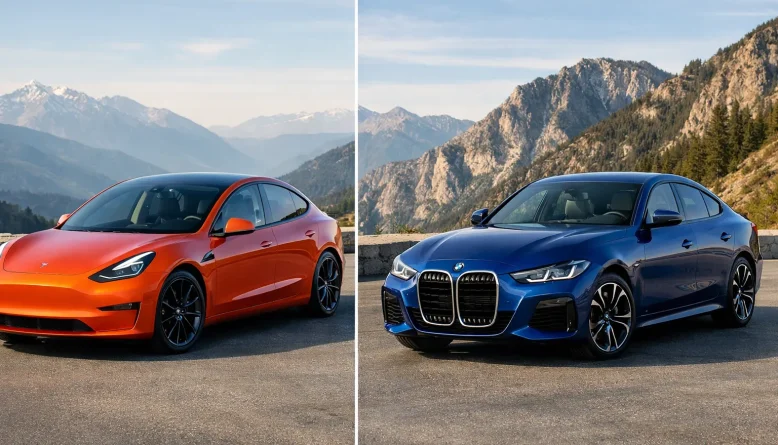
A 2024 Tesla Model 3 vs BMW i4 ownership comparison is fundamentally about how you want to live with an electric sedan day after day, not simply how fast it accelerates or how advanced the technology appears. The Model 3 prioritizes efficiency, charging convenience, and software-driven ownership, while the BMW i4 emphasizes familiarity, build quality, and a more traditional luxury experience adapted to an EV platform. Serious buyers cross-shopping these two are deciding whether they want an EV that feels radically different or one that feels reassuringly conventional over the long term.
Buyer Context and Market Positioning
Buyers comparing the 2024 Tesla Model 3 vs BMW i4 typically want a premium electric sedan that can serve as a primary vehicle. This is not an entry-level EV decision. These buyers already understand charging basics and are focused on daily usability, long-distance comfort, and long-term support.
The Tesla Model 3 competes as a high-volume electric sedan with a strong emphasis on efficiency, charging infrastructure, and frequent software updates. It appeals to buyers comfortable with a minimalist interface and a tech-first ownership model. The BMW i4 targets buyers transitioning from internal combustion luxury sedans who want an electric vehicle without abandoning familiar ergonomics, materials, and dealership support.
When buyers ask which should you buy, they are often deciding between innovation-led ownership and refinement-led ownership.
Pricing, Trims, and Real-World Value
Pricing structures differ significantly. The 2024 Tesla Model 3 lineup is relatively simple, with pricing that can change based on market conditions and incentives. Standard equipment levels are high, though customization options are limited.
The BMW i4 offers a broader trim range, including performance-oriented variants, with pricing that rises quickly as options are added. At similar transaction prices, the i4 typically includes more traditional luxury features and higher material quality, while the Model 3 delivers stronger efficiency and charging value.
Real-world value depends heavily on incentives, which vary by region and eligibility. Buyers should verify current programs, as these can materially affect ownership cost.
Powertrain, Performance, and Efficiency
Powertrain execution defines much of the ownership experience. The Tesla Model 3 uses a single-speed transmission with rear-wheel drive or dual-motor all-wheel drive depending on trim. Power delivery is immediate and smooth, making city driving and highway merging effortless.
The BMW i4 also uses single-speed electric drive units, with rear-wheel drive or all-wheel drive configurations depending on variant. Acceleration is strong, particularly in higher trims, but tuning favors linearity and control rather than abrupt response.
Efficiency and range vary by configuration and driving conditions. Official EPA or WLTP figures should be consulted for precise numbers. In real-world use, the Model 3 generally delivers stronger efficiency per kilowatt-hour, while the i4 trades some efficiency for weight, sound insulation, and ride composure.
Ride Quality, Handling, and Driving Character
Ride and handling reveal clear philosophical differences. The Tesla Model 3 feels light on its feet, with quick steering response and a firm suspension setup that prioritizes efficiency and agility. On rough pavement, ride quality can feel busy, particularly on larger wheels.
The BMW i4 feels more substantial and settled. Suspension tuning prioritizes comfort and body control, especially at highway speeds. Steering response is slower but more weighted, contributing to a calmer driving experience.
Over long-term ownership, the Model 3 suits drivers who enjoy immediacy and responsiveness, while the i4 favors those who value composure and refinement.
Interior Quality, Comfort, and Usability
Interior execution is one of the most polarizing aspects of this comparison. The Tesla Model 3 features an extremely minimalist cabin dominated by a central touchscreen. Material quality is functional, but physical controls are limited, which shifts much of the ownership experience into the software interface.
The BMW i4 offers a more traditional luxury interior with higher-grade materials, physical buttons, and a driver-focused layout. Seating comfort is strong, and the cabin feels more insulated from road and wind noise.
For long-term ownership, buyers who prefer simplicity and digital interaction may adapt easily to the Model 3, while those who value tactile controls and interior ambiance often prefer the i4.
Infotainment, Technology, and Driver Assistance
Technology is a core strength of the Model 3. Its infotainment system is fast, frequently updated, and deeply integrated into vehicle functions. Over-the-air updates can add features or improve performance, which is central to Tesla ownership.
The BMW i4 uses BMW’s latest infotainment system with a curved display and extensive customization. It integrates well with smartphones and provides a more conventional learning curve, though updates are less transformative than Tesla’s.
Driver-assistance systems are available on both vehicles, but capabilities and naming conventions differ by market. Buyers should confirm specific features, as functionality and availability vary and evolve.
Space, Practicality, and Daily Use
Practicality favors different strengths. The Tesla Model 3 offers a front trunk in addition to a rear trunk, which adds flexibility for daily use. Rear-seat space is adequate for adults, though roofline design limits headroom slightly.
The BMW i4 benefits from a hatchback-style rear opening, which improves cargo access and versatility. Rear-seat space is comparable, though the higher floor from the battery pack affects under-thigh support.
Daily usability often depends on how frequently the car carries passengers versus cargo.
Safety and Reliability Considerations
Both vehicles offer comprehensive safety equipment and have achieved strong crash-test results where ratings are available. Tesla relies heavily on camera-based systems and software updates, while BMW uses a more traditional sensor suite combined with established driver-assistance logic.
Reliability data for electric vehicles continues to evolve. Tesla’s simpler mechanical layout reduces some maintenance needs, but build consistency and service access vary by region. BMW benefits from established service networks, though long-term EV-specific reliability data remains limited.
Warranty coverage should be reviewed carefully by market, as terms differ.
Ownership Costs and Long-Term Perspective
Fuel costs strongly favor both EVs over combustion alternatives, though electricity pricing varies widely by region. Tesla’s Supercharger network remains a significant ownership advantage for frequent long-distance travel.
Maintenance expectations are generally lower than for gas vehicles, but tire wear and insurance costs can be higher for performance-oriented trims. Depreciation trends remain volatile, particularly for Tesla models due to pricing adjustments, while BMW depreciation follows more traditional luxury patterns.
Brand support and service accessibility often become decisive factors after the initial ownership period.
Verdict: Which Buyer Should Choose Which Car
In a 2024 Tesla Model 3 vs BMW i4 ownership comparison, the better choice depends on how you want your EV to integrate into your life. Buyers who prioritize charging convenience, software evolution, and maximum efficiency will likely find the Model 3 more compelling.
The BMW i4 suits buyers who want an electric sedan that feels familiar, refined, and traditionally premium, with strong dealership support and interior quality.
Neither approach is inherently better. The right decision comes down to whether you want ownership shaped by technology-first thinking or by established luxury norms, a distinction that becomes more important the longer you keep the car.
No Responses Yet