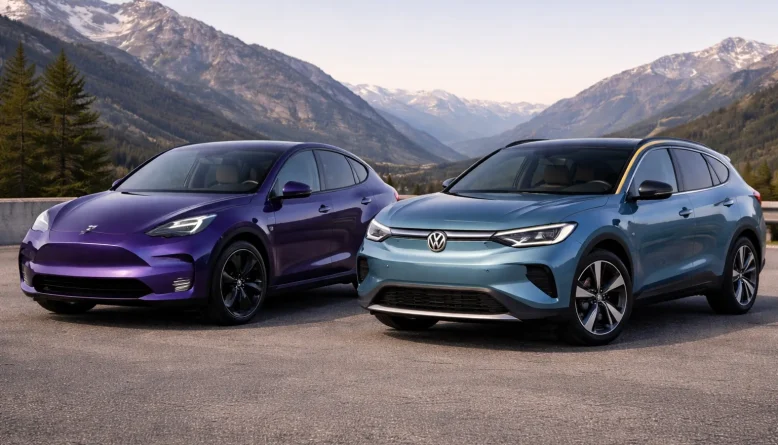
The 2024 Tesla Model Y vs Volkswagen ID.4 ownership question is less about which electric SUV looks better on paper and more about how each fits into daily life over several years. Both sit in the compact electric SUV segment and appeal to buyers ready to commit to full EV ownership, yet they differ sharply in charging ecosystem, software philosophy, interior execution, and long-term ownership expectations. For serious buyers cross-shopping alternatives, this comparison matters because these differences shape convenience, costs, and satisfaction long after the initial purchase.
Buyer Context and Market Positioning
Buyers comparing the 2024 Tesla Model Y vs Volkswagen ID.4 are typically transitioning from a gasoline vehicle and want an EV that can function as their primary car. This is a Car A vs Car B decision for households that value practicality and efficiency but may differ in tolerance for new technology and brand ecosystems.
The Model Y targets buyers who prioritize performance, software integration, and access to a proprietary charging network. The ID.4 appeals to those who want a more traditional ownership experience, familiar controls, and a dealership-based support structure. When asking which should you buy, the answer often hinges on how comfortable you are with Tesla’s minimalist approach versus Volkswagen’s conventional design and service model.
Pricing, Trims, and Real-World Value
Pricing for both vehicles varies significantly by market and trim. In the United States, the Model Y typically undercuts the ID.4 in base form after recent pricing adjustments, though incentives and regional availability can shift that balance. In Canada and Europe, pricing spreads depend heavily on battery size, drivetrain, and government incentives.
The Model Y trim structure is relatively simple, with pricing differences driven mainly by range and performance. The ID.4 offers a broader trim range, with multiple battery sizes and feature groupings, which allows more customization but can complicate comparisons.
Real-world value depends on usage. Buyers who rely on fast charging and frequent road trips may extract more value from the Model Y. Those who prioritize comfort, dealership support, and familiar ergonomics may see stronger value in the ID.4.
Powertrain, Performance, and Efficiency
Both vehicles use single-motor rear-wheel-drive and dual-motor all-wheel-drive configurations, depending on trim and market. The Model Y emphasizes performance, with brisk acceleration even in non-performance variants. Highway merging and passing require little planning, and power delivery feels immediate.
The ID.4 prioritizes smoothness over urgency. Acceleration is adequate for daily driving, especially in city traffic, but it feels less responsive during highway passing. This tuning suits buyers who value calm, predictable behavior rather than quick reactions.
Efficiency varies by configuration and driving style. Official range ratings differ by market testing standards, but in general, the Model Y delivers higher usable range at comparable battery sizes. Real-world efficiency, however, depends heavily on climate, speed, and charging habits.
Ride Quality, Handling, and Driving Character
Ride quality separates these two clearly. The ID.4 focuses on comfort, with suspension tuning that absorbs rough pavement effectively and keeps the cabin composed at urban speeds. Steering is light and relaxed, which suits commuting and long drives.
The Model Y feels firmer and more responsive. Steering is quicker, body control is tighter, and the vehicle feels more agile, though this comes at the cost of ride compliance on broken roads. Highway stability is strong in both, but the ID.4 maintains a calmer, quieter demeanor.
Driving character ultimately reflects priorities. The Model Y favors engagement and responsiveness. The ID.4 favors ease and comfort.
Interior Quality, Comfort, and Usability
Interior philosophy highlights the ownership difference. The Model Y uses a minimalist layout dominated by a central touchscreen, with few physical controls. Materials are durable but not luxurious, and usability depends heavily on comfort with screen-based interaction.
The ID.4 offers a more conventional cabin. Physical controls remain for key functions, and the layout feels familiar to drivers coming from traditional vehicles. Material quality is competitive, and seat comfort is strong for long trips.
Cabin noise levels favor the ID.4, especially at highway speeds. Visibility is good in both, though the Model Y’s low dash and expansive glass contribute to a more open feel.
Infotainment, Technology, and Driver Assistance
Technology is a defining factor in the 2024 Tesla Model Y vs Volkswagen ID.4 ownership debate. Tesla’s software is fast, integrated, and regularly updated over the air. Navigation, charging planning, and vehicle settings operate within a unified system.
The ID.4 infotainment system supports over-the-air updates in some markets, though functionality and frequency vary. Screen responsiveness has improved, but the system feels less cohesive than Tesla’s.
Driver assistance features are available on both, including adaptive cruise control and lane assistance. Tesla’s system integrates tightly with navigation, while Volkswagen’s systems feel more traditional and conservative in intervention.
Space, Practicality, and Daily Use
Both vehicles offer strong interior space for their size. Rear-seat legroom is generous, and cargo areas accommodate daily errands and travel. The Model Y benefits from a front trunk, adding flexibility for storage.
The ID.4’s cargo area is well shaped and easy to load, though it lacks a front trunk. Rear-seat access and child-seat installation are straightforward in both.
Daily use differences center more on interface and charging habits than on physical space.
Safety and Reliability Considerations
Both vehicles earn strong safety ratings where tested and include comprehensive standard safety equipment. Reliability data for the 2024 model year is still developing.
Tesla’s reliability record shows variability in build quality, though mechanical simplicity benefits long-term durability. Volkswagen’s EV reliability data is improving, but long-term trends remain limited compared to its gasoline models.
Warranty coverage varies by region, particularly for battery and drivetrain components.
Ownership Costs and Long-Term Perspective
Charging costs depend on home charging access and local electricity rates. The Model Y benefits from seamless integration with Tesla’s charging network, which reduces planning friction for long trips. The ID.4 relies on third-party charging networks, where availability and reliability vary by region.
Maintenance costs are low for both, reflecting EV simplicity. Depreciation trends remain volatile across the EV market, influenced by pricing changes and incentives rather than brand alone.
Verdict: Which Buyer Should Choose Which Car
The 2024 Tesla Model Y vs Volkswagen ID.4 ownership decision depends on how you value technology versus familiarity. Buyers who prioritize performance, software integration, and charging convenience will likely prefer the Model Y. It suits owners comfortable with a digital-first experience and minimal controls.
The ID.4 fits buyers who want a smoother ride, traditional cabin layout, and dealership-based support. It appeals to those easing into EV ownership without radically changing how they interact with their vehicle.
Neither choice is universally better. The right decision reflects how you plan to live with the car every day, not just how far it goes on a charge.

No Responses Yet