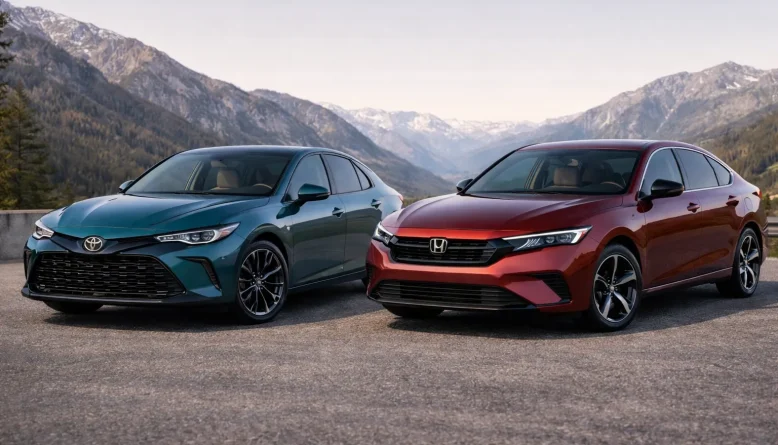
The 2025 Toyota Camry vs Honda Accord ownership comparison is fundamentally about how two long-standing midsize sedans now serve buyers with very different priorities, despite targeting the same practical, long-term ownership audience. For 2025, the Camry shifts to an all-hybrid lineup, while the Accord continues to offer both turbocharged gasoline and hybrid options. For serious buyers already cross-shopping alternatives, this comparison matters because these cars are chosen for durability, operating costs, and daily comfort over many years, not short-term novelty.
Buyer Context and Market Positioning
Buyers considering the 2025 Toyota Camry vs Honda Accord are typically replacing an older midsize sedan or downsizing from a crossover while still needing space, comfort, and predictable ownership costs. This is a classic Car A vs Car B decision in the global midsize sedan segment, where reliability, efficiency, and resale value often outweigh brand image.
The Camry positions itself as the conservative, efficiency-led choice with a strong emphasis on hybrid ownership and long-term dependability. The Accord leans toward a more balanced identity, offering a slightly more engaging driving experience and broader powertrain choice. When asking which should you buy, the answer often comes down to whether you want a simplified hybrid-only lineup or the flexibility of choosing between gasoline and hybrid power.
Pricing, Trims, and Real-World Value
At the time of writing, full global pricing details vary by market, but both the 2025 Camry and 2025 Accord remain positioned in the mainstream midsize sedan price band. In North America, the Camry’s move to standard hybrid power affects its entry price structure, while the Accord maintains a lower base price through its turbocharged gasoline trims.
In real-world terms, the Camry emphasizes value through standard efficiency rather than low entry pricing. Buyers no longer need to decide whether hybrid ownership is worth the premium, as it is now built into every Camry. The Accord offers more flexibility, allowing buyers to prioritize lower upfront cost or higher efficiency depending on trim.
Equipment levels at similar price points are competitive, with both vehicles offering advanced driver assistance systems and modern infotainment. Value differences emerge more from powertrain strategy than feature count.
Powertrain, Performance, and Efficiency
Powertrain philosophy is the defining factor in the 2025 Toyota Camry vs Honda Accord ownership comparison. For 2025, the Camry uses a hybrid system across the lineup, pairing a gasoline engine with electric assistance to prioritize fuel efficiency and smooth operation. Acceleration is adequate for daily use, with strong low-speed response that suits city driving and commuting.
The Accord continues to offer a turbocharged gasoline engine in lower trims, delivering responsive acceleration and confident highway merging. Its hybrid variant emphasizes efficiency, particularly in urban traffic, and provides a smoother, quieter driving experience than the gasoline model.
In everyday driving, the Accord feels slightly more responsive when accelerating at higher speeds, especially in gasoline form. The Camry prioritizes consistency and efficiency, rewarding drivers who value smoothness and predictable behavior over outright performance.
Ride Quality, Handling, and Driving Character
Ride quality differences reflect each car’s priorities. The Camry favors comfort and isolation, with suspension tuning that absorbs rough pavement well and keeps the cabin composed on long highway drives. Steering is light and predictable, reinforcing its relaxed character.
The Accord feels more composed and controlled through corners, with steering that offers clearer feedback. Body control is well managed, and the car feels stable at speed without becoming firm or uncomfortable.
For daily commuting, both cars are easy to live with. Drivers who enjoy a more connected feel may prefer the Accord, while those seeking a calmer, more isolated ride may gravitate toward the Camry.
Interior Quality, Comfort, and Usability
Interior execution plays a significant role in long-term satisfaction. The Camry’s cabin emphasizes clarity and ease of use, with controls laid out logically and materials chosen for durability. Seating comfort is strong, particularly for longer trips.
The Accord interior feels slightly more modern and airy, with a cleaner dashboard design and intuitive control placement. Front-seat comfort is excellent, and the driving position suits a wide range of body types.
Cabin noise levels are low in both vehicles, though the Camry’s hybrid system contributes to quieter operation at low speeds. Visibility is good in both, supporting daily usability and parking ease.
Infotainment, Technology, and Driver Assistance
Both sedans offer modern infotainment systems with standard smartphone integration. Screen sizes and responsiveness are competitive, and menu structures are easy to learn.
Driver assistance features are standard across most trims, including adaptive cruise control, lane-keeping assistance, and automatic emergency braking. In real-world use, both systems function smoothly, though Honda’s tuning often feels slightly more natural in lane-centering behavior.
Technology differences are incremental rather than decisive, making usability preferences more important than feature lists.
Space, Practicality, and Daily Use
Rear-seat space is generous in both vehicles, comfortably accommodating adults. Trunk capacity is suitable for family errands and road trips, with wide openings that simplify loading.
Both cars handle child-seat installation well, supported by accessible anchors and wide-opening doors. Daily practicality is strong in either case, with no meaningful compromises for typical ownership needs.
Safety and Reliability Considerations
Both the Camry and Accord have long-standing reputations for safety and earn strong crash-test ratings where evaluated. Standard safety equipment is comprehensive in both lineups.
Reliability expectations remain high for both brands. Long-term data for the 2025 model year is still developing, particularly for the Camry’s all-hybrid strategy, though Toyota’s hybrid track record is well established. Warranty coverage is typical for the segment.
Ownership Costs and Long-Term Perspective
Fuel costs favor the Camry due to its standard hybrid configuration, particularly for high-mileage drivers. The Accord hybrid offers similar benefits, while gasoline Accord trims trade efficiency for lower upfront cost.
Maintenance costs are expected to remain moderate for both, with strong dealer networks supporting ownership globally. Depreciation trends historically favor both nameplates, with the Camry often holding value slightly more consistently in some markets.
Verdict: Which Buyer Should Choose Which Car
The 2025 Toyota Camry vs Honda Accord ownership comparison does not produce a universal answer. Buyers who want simplified decision-making, strong fuel efficiency across the board, and a calm driving experience will likely prefer the Camry.
The Accord suits buyers who want flexibility in powertrain choice and a slightly more engaging driving character, without sacrificing comfort or reliability.
Both remain excellent long-term ownership choices. The better option depends on whether efficiency standardization or choice and driving feel define your priorities.

No Responses Yet