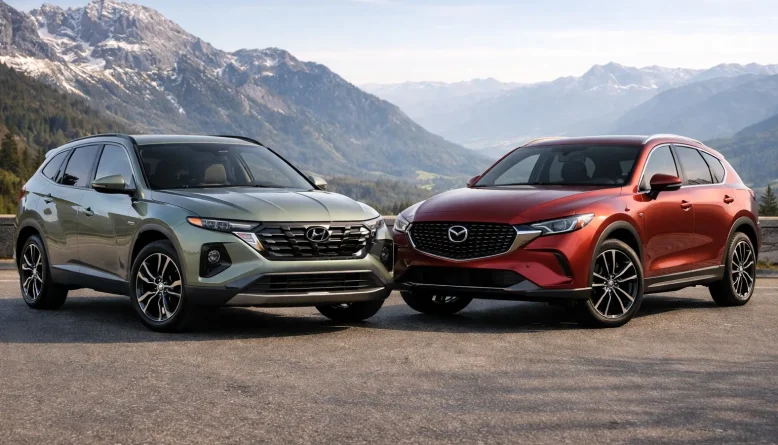
The 2025 Hyundai Tucson vs Mazda CX-5 real-world review is about how two compact SUVs with very different design and engineering philosophies perform in everyday ownership, not how they compare on a brochure. Both target buyers who want a manageable-size SUV with modern safety, reasonable efficiency, and long-term usability, yet they diverge meaningfully in ride comfort, interior execution, powertrain strategy, and ownership priorities. For buyers actively cross-shopping alternatives, this comparison matters because these differences show up daily, not just on a test drive.
Buyer Context and Market Positioning
Buyers comparing the 2025 Hyundai Tucson vs Mazda CX-5 are typically moving out of sedans or older compact SUVs and want something comfortable, efficient, and easy to live with. This is a Car A vs Car B decision at the core of the compact SUV segment, where practicality and value matter more than outright performance.
The Tucson positions itself as a tech-forward, space-efficient choice with broad powertrain availability, including hybrid options in many markets. The CX-5 targets buyers who value driving feel, upscale interior design, and a more traditional ownership experience. When asking which should you buy, the answer usually comes down to whether comfort and technology or driving character and interior refinement matter more.
Pricing, Trims, and Real-World Value
In the United States, the 2025 Hyundai Tucson and 2025 Mazda CX-5 occupy similar price territory, starting in the high-$20,000 to low-$30,000 range before destination. Canadian and European pricing follows comparable positioning once regional taxes and equipment differences are considered.
At similar transaction prices, the Tucson typically offers more visible technology and space, especially in lower trims. The CX-5 often feels more premium inside at equivalent pricing, though higher trims are required to access advanced features.
Real-world value depends on priorities. Buyers focused on efficiency and interior room may find the Tucson delivers more for the money. Those who value material quality and cohesive design may see stronger value in the CX-5, even if feature counts appear similar on paper.
Powertrain, Performance, and Efficiency
Powertrain strategy is a key divider in the 2025 Hyundai Tucson vs Mazda CX-5 real-world review. The Tucson offers a naturally aspirated four-cylinder engine as standard, with available hybrid and plug-in hybrid variants in many markets. These electrified options emphasize fuel efficiency and smooth low-speed response.
The CX-5 relies primarily on gasoline engines, including a naturally aspirated four-cylinder and an available turbocharged option. The turbo engine provides noticeably stronger acceleration, particularly during highway merging and passing.
In everyday driving, the Tucson hybrid feels responsive around town and relaxed on the highway, prioritizing efficiency over urgency. The CX-5, especially with the turbo engine, feels more confident under acceleration but consumes more fuel. Official fuel economy ratings favor the Tucson hybrid, though real-world results depend on driving style and conditions.
Ride Quality, Handling, and Driving Character
Ride and handling differences define ownership feel. The Tucson favors comfort, with suspension tuning that absorbs rough pavement well and keeps the cabin composed during daily commuting. Steering is light and predictable, reinforcing its easygoing nature.
The CX-5 emphasizes control and feedback. Steering feels more direct, body movements are well managed, and the vehicle feels more planted on winding roads. This makes the Mazda more engaging to drive, though the ride is firmer over broken surfaces.
On long highway trips, both remain stable. The Tucson feels calmer and more relaxed, while the CX-5 feels more connected but slightly less forgiving.
Interior Quality, Comfort, and Usability
Interior execution highlights different priorities. The Tucson features a modern, tech-heavy cabin with integrated digital displays and a clean, contemporary layout. Seat comfort is strong, and rear-seat space is generous for the class.
The CX-5 interior feels more upscale, with higher perceived material quality and a more traditional control layout. Physical buttons and knobs make daily interaction intuitive, and front-seat comfort is excellent.
Cabin noise levels are low in both, though the Tucson’s hybrid powertrain contributes to quieter operation at low speeds. Visibility is good in each, though the CX-5’s higher beltline slightly reduces outward sightlines.
Infotainment, Technology, and Driver Assistance
Both vehicles offer modern infotainment systems with standard smartphone integration. The Tucson’s larger screens and digital interfaces feel more current, though some functions rely heavily on touch controls.
The CX-5’s system emphasizes simplicity and ease of use. While screen sizes are smaller, the interface is straightforward and less distracting in daily driving.
Driver assistance features are standard across most trims for both, including adaptive cruise control and lane-keeping assistance. In real-world use, both systems operate smoothly, though Mazda’s tuning often feels less intrusive.
Space, Practicality, and Daily Use
Space is an area where the Tucson clearly benefits. Rear-seat legroom and cargo capacity are generous, making it easier to accommodate families, pets, or frequent road trips.
The CX-5 offers adequate space for daily use, but rear-seat and cargo room trail the Tucson. For smaller households, this may not matter, but frequent passengers will notice the difference.
Both vehicles handle child-seat installation well, though the Tucson’s wider rear-door openings make the process easier.
Safety and Reliability Considerations
Both the Tucson and CX-5 earn strong safety ratings where tested and include comprehensive standard safety equipment. Warranty coverage favors Hyundai in many markets, particularly in North America.
Reliability trends historically favor both brands, with Mazda showing strong recent results and Hyundai benefiting from extensive warranty coverage. Long-term data for the 2025 model year is still developing.
Ownership Costs and Long-Term Perspective
Fuel costs favor the Tucson, especially in hybrid form, making it attractive for high-mileage drivers. Maintenance costs are typical for the segment, though turbocharged CX-5 models may carry higher long-term service considerations.
Depreciation trends vary by region. Mazda often benefits from strong owner loyalty, while Hyundai’s warranty support can offset resale concerns for long-term owners.
Verdict: Which Buyer Should Choose Which Car
The 2025 Hyundai Tucson vs Mazda CX-5 real-world review does not produce a single winner. Buyers who prioritize interior space, modern technology, and fuel efficiency will likely find the Tucson better aligned with their needs.
The CX-5 suits buyers who value driving engagement, interior refinement, and a more traditional, premium-feeling cabin. It appeals to those who enjoy the act of driving as much as the destination.
The better choice depends on how you plan to live with the vehicle every day, not which one looks better on paper.

No Responses Yet