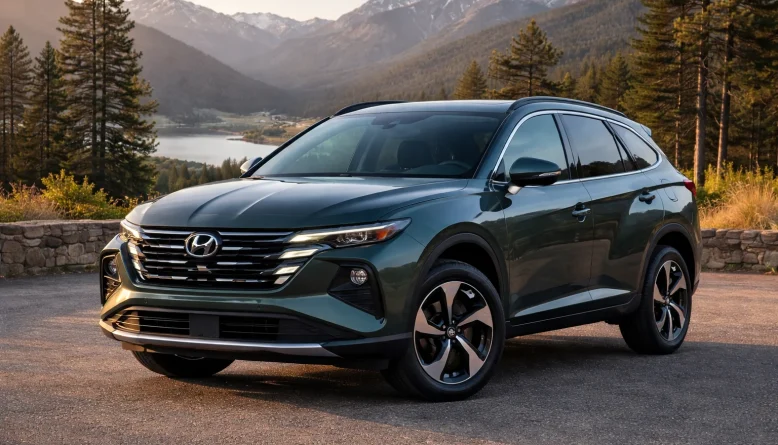
Hybrid shopping in 2026 feels less about ideology and more about trust. Buyers want to know if the promised fuel savings actually show up after six months, if the driving experience feels natural, and if long-term reliability will justify the price premium. That is where the 2026 Hyundai Tucson finds itself, appealing to cautious buyers who want efficiency without complexity and modern features without wondering what ownership looks like in year five.
Overview
The 2026 Hyundai Tucson continues to anchor Hyundai’s hybrid strategy in the compact SUV segment. It is not positioned as a performance hybrid or a technology experiment. Instead, it aims to be a dependable, well-rounded daily driver that quietly reduces fuel costs while maintaining the comfort and usability buyers expect from a mainstream crossover. That focus shapes nearly every decision behind the Tucson hybrid.
What’s New
Hyundai has not announced a full redesign for the 2026 model year. Current reporting suggests the Tucson carries forward with modest updates rather than major mechanical changes. These updates are expected to focus on feature availability, software improvements, and minor trim adjustments. For hybrid buyers, that continuity signals a system that has already been vetted in the real world.
Exterior
The Tucson’s exterior design remains distinctive. Sharp angles and a bold front fascia give it a more modern presence than many conservative rivals. While the styling can divide opinion, it avoids blending into traffic. From an ownership perspective, that uniqueness helps the Tucson feel newer for longer, which matters when resale time eventually arrives.
Interior
Inside, the Tucson offers a cabin that feels airy and well organized. Seating comfort stands out, especially in the front, with cushioning that supports longer drives without fatigue. Rear-seat legroom is generous for the class, making it easy to accommodate adults or growing kids. Cargo space remains competitive, even with the hybrid components under the floor.
Interior & Build Quality
Build quality reflects Hyundai’s recent push upmarket. Materials feel solid and well assembled, with few squeaks or rattles over rough pavement. The interior does not feel luxurious, but it does feel durable. That balance suits buyers who plan to keep their vehicle well past the warranty period.
Infotainment & Technology
The infotainment system relies heavily on touch controls, which look clean but can require acclimation. Once familiar, the interface is responsive and integrates smartphone connectivity seamlessly. Digital displays provide clear information about hybrid operation, helping owners understand how the system behaves without overwhelming them.
Powertrain / Hybrid System – 2026 Hyundai Tucson
The 2026 Hyundai Tucson hybrid pairs a gasoline engine with an electric motor and battery designed for self-charging operation. In daily city driving, the system frequently operates in EV-only mode at low speeds. Transitions between electric and gasoline power feel smooth and unobtrusive, which helps the Tucson avoid the artificial feel some hybrids still exhibit.
Performance
Performance is tuned for everyday use rather than excitement. Electric assist improves low-speed throttle response compared to the gas-only Tucson, making stop-and-go traffic easier to manage. Highway passing is competent, though not urgent. The added hybrid weight slightly softens handling, but stability remains predictable and reassuring.
Efficiency / MPG – 2026 Hyundai Tucson
Real-world fuel economy tends to align closely with expectations, particularly in urban and mixed driving. The Tucson hybrid delivers its best efficiency when driven smoothly, rewarding consistent habits rather than aggressive acceleration. Highway MPG drops modestly at sustained speeds, but overall efficiency remains a meaningful improvement over non-hybrid versions.
Driving Modes & Real-World Use
Driving modes offer limited but useful adjustments. Most owners will leave the Tucson in its default setting, where the hybrid system manages power sources intelligently. Cold weather reduces electric-only operation, though not enough to undermine daily efficiency. The Tucson adapts well to varied driving patterns without requiring constant input.
Safety
Safety remains a strong point for the Tucson. Crash-test performance continues to inspire confidence, and the vehicle feels stable during emergency maneuvers. For families and commuters alike, this contributes to a sense of security that matters more than headline performance figures.
Driver Assistance
Driver assistance features operate smoothly and without excessive intervention. Adaptive cruise control and lane-centering reduce fatigue on long highway drives. These systems feel calibrated for real traffic rather than ideal conditions, which enhances trust over time.
Trims, Options & Pricing
Pricing for the 2026 Hyundai Tucson has not been officially confirmed. Historically, the hybrid carries a reasonable premium over gas models, often offset by fuel savings and strong feature content. Hyundai’s trim structure allows access to hybrid power without forcing buyers into top-tier pricing.
Release Date – 2026 Hyundai Tucson
Hyundai has not confirmed an exact release date. Based on prior model cycles and manufacturer guidance, the 2026 Hyundai Tucson is expected to arrive later in 2025 or in early 2026. Buyers should rely on official announcements rather than speculation.
Key Pros & Cons
The Tucson hybrid delivers consistent fuel savings in daily driving. Electric-only operation improves low-speed smoothness. Interior space is generous for passengers and cargo. Build quality supports long-term ownership confidence. Technology features feel modern without being overwhelming. Warranty coverage adds reassurance for hybrid components.
Highway efficiency trails city driving noticeably. Touch-heavy controls may frustrate some drivers. Styling can polarize conservative buyers. Performance remains functional rather than engaging. Resale values lag behind some Japanese rivals. Hybrid system adds weight that slightly affects handling.
Competitors / Rivals
The Tucson hybrid competes with the Toyota RAV4 Hybrid, Honda CR-V Hybrid, Kia Sportage Hybrid, and Ford Escape Hybrid. Toyota emphasizes efficiency and resale strength. Honda focuses on refinement and space. Kia leans into design and value. The Tucson positions itself as a balanced option with strong features and predictable ownership costs.
Final Verdict
The 2026 Hyundai Tucson succeeds by delivering hybrid benefits without demanding compromises. It offers real-world efficiency, usable space, and a driving experience that feels natural rather than engineered. For buyers who want dependable savings and modern design without complexity, the Tucson remains one of the most sensible hybrid SUVs in its class.

No Responses Yet