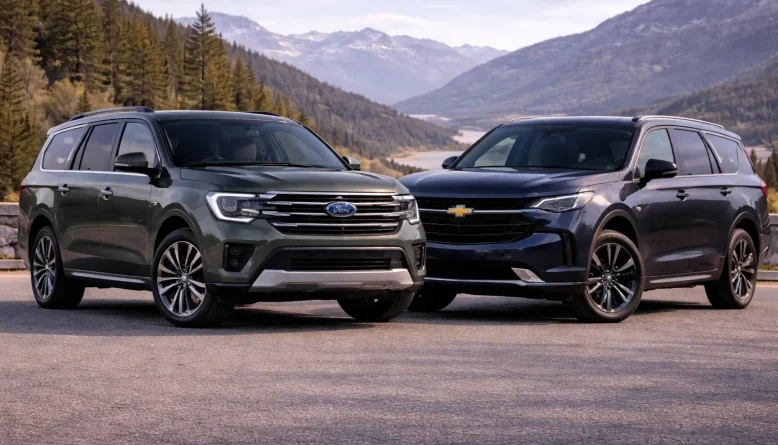
This 2026 Ford Expedition vs Chevrolet Tahoe buyer guide comes down to how each SUV balances size, powertrain philosophy, and long-term ownership priorities rather than raw capability alone. As of now, full and final 2026 specifications, pricing, and EPA fuel economy ratings have not been completely released for either vehicle. What can be evaluated reliably is how each platform has historically performed in everyday use, towing stability, passenger comfort, and ownership costs. For buyers cross-shopping these two full-size SUVs, understanding those patterns is far more useful than focusing on a single headline number.
Buyer Context and Market Positioning
The buyer comparing a 2026 Ford Expedition vs Chevrolet Tahoe typically needs a true full-size SUV. This includes families who regularly carry multiple passengers, owners who tow boats or travel trailers, and buyers who want commanding road presence without stepping up to a heavy-duty truck. The comparison matters because these vehicles dominate the traditional body-on-frame SUV segment but approach the mission differently.
The Expedition emphasizes interior space efficiency and lighter overall feel, aided by its long-standing focus on maximizing cabin volume. The Tahoe positions itself as a more traditional, truck-derived SUV with an emphasis on solidity and mechanical familiarity. When asking which should you buy, the decision often centers on whether interior flexibility or traditional SUV character matters more over years of ownership.
Pricing, Trims, and Real-World Value
Official 2026 MSRP ranges have not yet been confirmed for either model. Historically, both the Expedition and Tahoe have spanned wide price ranges, from relatively accessible base trims to high-end configurations with luxury-oriented features.
In real-world terms, the Expedition has often delivered more usable interior space at comparable price points, which can improve perceived value for large families. The Tahoe has typically offered stronger brand loyalty and resale performance, especially in truck-centric markets. Buyers should look beyond base pricing and evaluate how quickly costs rise when adding four-wheel drive, towing packages, and comfort features that materially affect daily use.
Powertrain, Performance, and Efficiency
Final 2026 powertrain lineups remain unconfirmed. Historically, the Expedition has relied on turbocharged engines designed to deliver strong low-end torque and consistent performance under load. This approach often benefits towing and highway merging, even when the vehicle is fully occupied.
The Tahoe has traditionally offered larger-displacement engines that emphasize smooth power delivery and mechanical simplicity. In everyday driving, this often translates into predictable throttle response and a more familiar feel for buyers accustomed to trucks. Fuel economy ratings for 2026 are not yet available, but prior generations have shown relatively small real-world differences once vehicle size and usage are factored in.
Ride Quality, Handling, and Driving Character
Ride quality is a key differentiator in this buyer guide. The Expedition has historically felt lighter on its feet, with steering and suspension tuning that reduce the sense of mass in daily driving. This can be beneficial in urban environments and long highway trips.
The Tahoe typically feels heavier and more planted, which some drivers interpret as confidence-inspiring, especially when towing or driving on rough roads. Body control prioritizes stability over agility. Buyers should consider how often the vehicle will be driven in tight spaces versus open highways and rural areas.
Interior Quality, Comfort, and Usability
Interior execution directly affects long-term satisfaction. The Expedition has traditionally focused on maximizing usable space, with flatter floors and easier access to third-row seating. This design benefits families who regularly use all three rows.
The Tahoe’s interior tends to feel more substantial, with a layout that emphasizes durability and a truck-like driving position. Material quality and seat comfort have generally been competitive in both, though the Expedition often feels more accommodating for third-row passengers during longer trips.
Infotainment, Technology, and Driver Assistance
Infotainment and driver-assistance details for 2026 have not been fully released. Historically, Ford has leaned into feature-rich systems with extensive customization options, while Chevrolet has emphasized familiarity and straightforward operation.
From an ownership perspective, ease of use and long-term reliability often matter more than screen size or feature count. Buyers planning extended ownership should consider how intuitive the systems feel in daily use rather than how advanced they appear at launch.
Space, Practicality, and Daily Use
Space utilization remains one of the Expedition’s strongest arguments. Its interior packaging has historically allowed more cargo space behind the third row, which reduces the need to choose between passengers and luggage.
The Tahoe counters with a wide, robust cargo area that supports heavy-duty use and easier loading of bulky items. Daily practicality depends on whether the vehicle is used primarily for people-moving or mixed-duty hauling.
Safety and Reliability Considerations
Crash-test ratings for the 2026 model year are not yet available. Both manufacturers have strong safety track records and typically include a wide range of standard active safety features.
Reliability perceptions differ slightly. The Tahoe benefits from long-running mechanical architectures with well-documented service histories. The Expedition’s engineering has emphasized efficiency and performance, which can introduce more variability depending on usage and maintenance. There is no confirmed evidence indicating a significant reliability shift for 2026.
Ownership Costs and Long-Term Perspective
Fuel costs, maintenance, and depreciation dominate long-term ownership. Without confirmed 2026 fuel economy data, cost comparisons must rely on historical trends. Both vehicles are expensive to operate relative to smaller SUVs, though ownership costs are broadly similar when used for their intended purposes.
Depreciation has historically favored the Tahoe slightly in many regions, particularly where truck-based SUVs are in high demand. The Expedition’s advantage often comes from interior utility rather than resale metrics alone.
Verdict: Which Buyer Should Choose Which Car
In this 2026 Ford Expedition vs Chevrolet Tahoe buyer guide, the Expedition is best suited to buyers who prioritize interior space efficiency, family comfort, and a lighter driving feel in a very large vehicle. The Tahoe fits buyers who want traditional SUV character, strong resale confidence, and a driving experience that feels closely related to a full-size pickup.
Neither SUV is objectively better. The right choice depends on whether your ownership priorities center on maximizing interior usability or embracing a more traditional, truck-like full-size SUV experience over the long term.

No Responses Yet