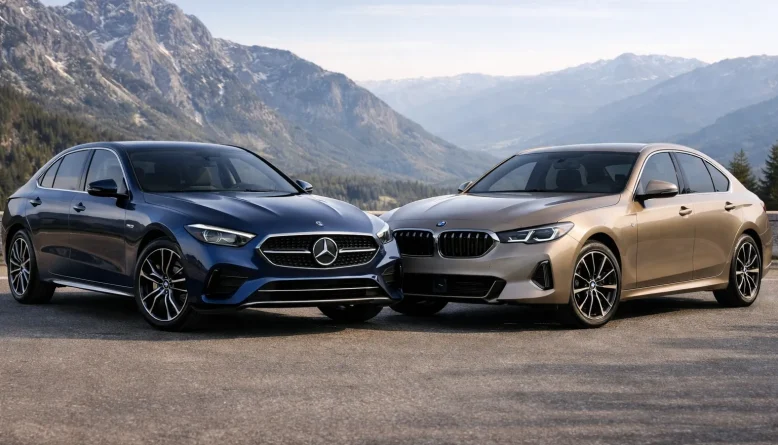
The 2025 Mercedes-Benz E-Class vs BMW 5 Series review centers on how two newly updated midsize luxury sedans interpret modern premium ownership in very different ways. Both are core products for their brands and target buyers who want comfort, technology, and long-term refinement without moving into full-size luxury territory. For serious buyers cross-shopping alternatives, this comparison matters because the E-Class and 5 Series diverge sharply in ride philosophy, interior execution, and how they balance comfort with driver involvement over years of ownership.
Buyer Context and Market Positioning
Buyers considering the 2025 Mercedes-Benz E-Class vs BMW 5 Series are typically professionals or families stepping up from compact luxury sedans or downsizing from larger vehicles. This is a Car A vs Car B decision within the global midsize luxury sedan segment, where expectations extend beyond performance into daily comfort, technology integration, and brand experience.
The E-Class positions itself as the comfort and technology benchmark, emphasizing ride isolation, advanced driver assistance, and a luxury-first cabin. The 5 Series leans toward buyers who still value driving engagement and chassis balance, even in a modern, tech-heavy sedan. When asking which should you buy, the answer often comes down to whether you prioritize serenity or involvement.
Pricing, Trims, and Real-World Value
Pricing varies by market and powertrain, but both the 2025 E-Class and 2025 5 Series sit firmly in the upper tier of midsize luxury sedans. In North America and Europe, starting prices are broadly comparable, with differences emerging as trims and powertrains escalate.
The E-Class typically includes a high level of standard technology and comfort features, though premium packages quickly raise transaction prices. Mercedes-Benz emphasizes bundled luxury and driver-assistance options that align with its flagship positioning.
The 5 Series offers a slightly more modular approach. Buyers can configure performance, luxury, and technology features more selectively, which can result in a lower entry point or a highly personalized build. Real-world value depends on configuration, with neither model clearly undercutting the other once similarly equipped.
Powertrain, Performance, and Efficiency
Powertrain offerings vary by region, but both models rely primarily on turbocharged four- and six-cylinder engines with electrification elements such as mild-hybrid systems. Plug-in hybrid variants are available in many markets, targeting buyers who want short-distance electric driving alongside gasoline flexibility.
In everyday driving, the 5 Series feels more responsive under throttle, particularly during highway merging and passing. Steering and power delivery give it a more athletic character, even in non-performance trims.
The E-Class prioritizes smoothness. Acceleration is refined rather than urgent, and power delivery feels seamless in urban traffic. Efficiency figures are competitive for the segment, though real-world fuel economy depends heavily on driving style and whether electrified variants are chosen.
Ride Quality, Handling, and Driving Character
Ride quality defines the ownership experience for many buyers. The E-Class excels at isolation, with suspension tuning that absorbs rough pavement and expansion joints effortlessly. Long highway drives feel relaxed, and cabin calmness remains a defining trait.
The 5 Series strikes a firmer balance. Body control is tighter, steering feedback is clearer, and the car feels more composed through corners. While still comfortable, it communicates more road texture than the E-Class.
Drivers who enjoy a sense of connection will gravitate toward the BMW. Those who value effortless comfort and reduced fatigue will likely prefer the Mercedes-Benz.
Interior Quality, Comfort, and Usability
Interior execution highlights the philosophical split. The E-Class adopts a technology-forward, lounge-like cabin with expansive displays and ambient lighting. Materials feel premium, and seat comfort is exceptional for long distances.
The 5 Series interior feels more restrained and driver-focused. Materials are equally high quality, but the layout prioritizes clarity and ergonomics over visual drama. Physical controls remain more prominent, which some owners prefer for daily use.
Cabin noise levels are low in both, though the E-Class maintains a slight advantage in overall quietness. Visibility is good in each, though thick pillars and high beltlines reflect modern safety standards rather than driver-centric design.
Infotainment, Technology, and Driver Assistance
Technology plays a central role in both vehicles. The E-Class integrates many functions into its digital interface, including climate controls and driver settings. The system is visually impressive, though it can require acclimation.
The 5 Series balances touchscreen interaction with physical controls, reducing reliance on menus while driving. Responsiveness is strong, and smartphone integration is seamless in both vehicles.
Driver assistance systems are comprehensive in each, including adaptive cruise control and lane-centering features. Mercedes-Benz systems tend to intervene earlier and more assertively, while BMW’s tuning feels slightly more natural once calibrated.
Space, Practicality, and Daily Use
Rear-seat space is generous in both sedans, accommodating adults comfortably. Trunk capacity supports daily errands and travel, though neither leads the segment for outright cargo volume.
Both vehicles handle child-seat installation competently, and rear-door openings are adequate. Practicality differences are subtle and unlikely to determine the purchase decision.
Safety and Reliability Considerations
Both models earn strong safety ratings where tested and include extensive standard safety equipment. Advanced driver assistance is a core strength for each brand.
Reliability data for the 2025 model year is still developing. Historically, both brands show average reliability in this segment, with ownership experience influenced heavily by maintenance practices and dealer support quality. Warranty coverage is typical for the luxury class and varies by region.
Ownership Costs and Long-Term Perspective
Ownership costs align with luxury-segment expectations. Fuel costs depend on powertrain choice, with plug-in hybrid variants offering potential savings for short-distance driving. Maintenance and repair costs are higher than mainstream sedans but consistent with premium positioning.
Depreciation trends vary by market. Historically, the E-Class often appeals to buyers seeking long-term comfort, while the 5 Series attracts enthusiasts, influencing resale patterns differently rather than decisively favoring one.
Verdict: Which Buyer Should Choose Which Car
The 2025 Mercedes-Benz E-Class vs BMW 5 Series review does not reveal a universal winner. Buyers who prioritize comfort, advanced technology, and a serene driving environment will likely find the E-Class better aligned with their needs.
The 5 Series suits buyers who want sharper driving dynamics, clearer steering feedback, and a more traditional, driver-focused interior without sacrificing luxury. It rewards those who still enjoy the act of driving.
Both are excellent luxury sedans. The better choice depends on whether your ownership priorities lean toward tranquility or engagement over the long term.

No Responses Yet