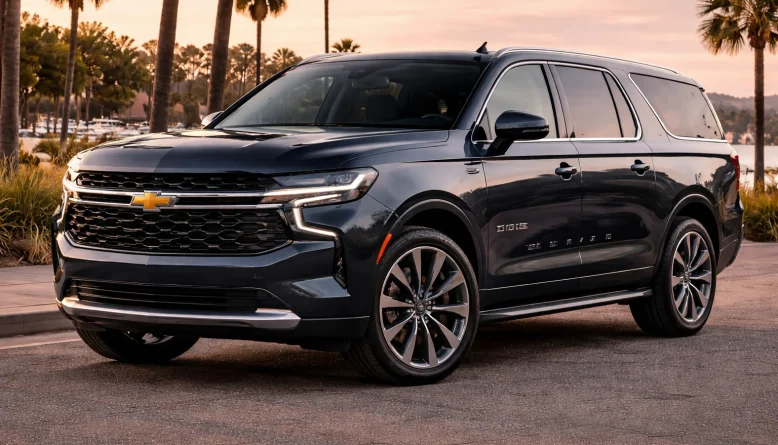
Full-size SUV buyers usually know what they are giving up before they sign the paperwork. Vehicle mass works against fuel economy. Long wheelbases improve ride comfort but complicate parking and daily maneuvering. Powerful engines inspire confidence, yet raise operating costs that surface over years, not months. The 2026 Chevrolet Suburban sits directly in that reality. It remains one of the largest and most capable SUVs available, and buyers cross-shopping it against other full-size gas-powered SUVs are deciding whether maximum space and towing capability still outweigh the everyday compromises.
Market Position and Purpose
The 2026 Chevrolet Suburban occupies the long-wheelbase end of the full-size SUV segment. It sits above the Tahoe in length and cargo capacity and competes directly with vehicles such as the Ford Expedition Max and GMC Yukon XL. Pricing historically places the Suburban above midsize SUVs and well into full-size territory, though still below luxury-branded alternatives when similarly equipped.
From a product-planning perspective, the Suburban exists to serve buyers who need consistent passenger space and cargo volume without stepping into commercial vehicles. Its role is not efficiency leadership or urban convenience, but long-haul comfort, towing stability, and interior flexibility that smaller SUVs cannot replicate.
What’s New
As of this writing, Chevrolet has not released confirmed, model-year-specific updates for the 2026 Chevrolet Suburban. The most recent significant changes came with the current generation, which introduced an independent rear suspension, improved ride quality, and updated interior technology. If the 2026 model carries over largely unchanged, that continuity matters because the Suburban’s mechanical and packaging strengths are already well established. Buyers should not expect meaningful changes unless Chevrolet announces them closer to launch.
The Exterior
The Suburban’s exterior design reflects its function clearly. Length is the defining feature, and it directly contributes to interior volume and towing stability. Visibility remains good for a vehicle of this size thanks to an upright driving position and large glass area, though rearward awareness relies heavily on mirrors and cameras.
Ride height aids ground clearance and towing confidence but requires attention when entering parking structures. Wheel sizes vary by trim, with larger wheels trading ride comfort for appearance. Aerodynamic efficiency is secondary to packaging, and that choice shows up in real-world fuel consumption.
Real-World Driving Experience
In daily driving, the Suburban feels large but controlled. Throttle response is tuned for smoothness rather than urgency, which suits urban and suburban traffic. The 10-speed automatic transmission shifts unobtrusively, keeping engine speeds low during light throttle operation.
Steering is light relative to the vehicle’s size, helping reduce fatigue in routine driving. Body control has improved significantly compared with older generations, though quick direction changes still reveal the Suburban’s mass. Braking behavior is predictable, with a firm pedal feel that inspires confidence when carrying passengers or cargo.
Performance
Performance depends heavily on powertrain choice. The standard 5.3-liter V8 provides adequate acceleration for daily use and highway merging, though it works harder under full load. The available 6.2-liter V8 delivers stronger passing response and more relaxed performance when towing or driving at elevation.
The available 3.0-liter Duramax diesel emphasizes torque delivery rather than acceleration. In real-world conditions, it moves the Suburban with less effort under load, which matters more than outright speed for many owners.
Powertrain Behavior and Efficiency in Daily Use
Fuel economy remains a defining trade-off. Gasoline V8 models typically return combined fuel economy in the mid-teens, depending on drivetrain and wheel size. Real-world results generally align with EPA ratings, particularly in mixed driving.
The diesel option offers a noticeable efficiency advantage, often reaching combined figures in the low 20-mpg range with strong highway efficiency. In daily use, the diesel’s torque reduces throttle input and supports consistent mileage, especially on long trips or when towing.
Interior Design, Ergonomics, and Vehicle-Specific Technology
Interior space is the Suburban’s primary advantage. Seating comfort is good in all three rows, with adult-usable space even in the third row. The long wheelbase improves ride comfort for rear passengers and reduces head toss over uneven surfaces.
Controls are logically arranged, with physical buttons for key functions that remain easy to use while driving. Materials quality varies by trim, ranging from durable surfaces in lower trims to more refined finishes in higher trims. Visibility from the driver’s seat remains strong, reinforcing confidence despite the vehicle’s size.
Infotainment and Technology
Chevrolet’s infotainment system is responsive and easy to navigate. Menu structure is intuitive, and smartphone integration works reliably, reducing dependence on built-in navigation. Voice controls handle basic tasks well. Owner feedback has generally been positive regarding stability and ease of use over time.
Driver Assistance and Safety
Driver assistance features such as adaptive cruise control and lane-keeping assistance are available across much of the lineup. In real-world use, adaptive cruise maintains smooth following distances, while lane-centering works best on clearly marked highways. In a vehicle this long, the systems are tuned conservatively, prioritizing stability over aggressive corrections. Braking predictability remains consistent, even when the vehicle is fully loaded.
Ride Comfort, Noise Levels, and Long-Distance Behavior
Ride comfort is a strength, particularly on longer trips. The suspension absorbs highway imperfections well, and the extended wheelbase smooths out undulations that shorter SUVs transmit more directly. Wind and road noise are present but controlled at cruising speeds.
Engine sound varies by powertrain. The V8s produce a subdued but audible tone under load, while the diesel remains quieter and more relaxed during sustained cruising. Over long distances, seating comfort and stable behavior help limit driver fatigue.
Practicality and Everyday SUV Ownership Scenarios
Cargo capacity is where the Suburban differentiates itself. With the third row folded, it offers a vast, flat load floor capable of handling large family gear, construction materials, or extended road-trip luggage. Even with all three rows in use, cargo space remains usable.
Ingress and egress are straightforward, though vehicle length demands attention in tight urban environments. Daily commuting is manageable but fuel stops are frequent compared with smaller SUVs. Towing capability is a major advantage, with properly equipped Suburbans rated to tow up to approximately 8,300 pounds, depending on configuration.
Trims, Options, and Pricing
The Suburban lineup typically includes LS, LT, RST, Z71, Premier, and High Country trims. Pricing in recent model years has started in the high-$50,000 range and extended into the mid-$70,000s for well-equipped versions. Official MSRP pricing for the 2026 Chevrolet Suburban has not yet been released and should be confirmed once Chevrolet publishes updated order guides.
Release Date
Chevrolet has not announced a confirmed release date for the 2026 Suburban. Availability is expected to follow Chevrolet’s standard model-year rollout schedule, but buyers should rely on official announcements rather than assumptions.
Comparison With Direct Gas-Powered SUV Competitors
Buyers typically cross-shop the Suburban with the Ford Expedition Max and GMC Yukon XL. Compared with the Expedition Max, the Suburban emphasizes powertrain variety and interior familiarity. Against the Yukon XL, it offers similar capability with slightly different pricing and trim emphasis. All trade efficiency for size and capacity, leaving buyers to prioritize packaging and brand preference.
Strengths, Weaknesses, and SUV Ownership Trade-Offs
The Suburban excels in interior volume, long-distance comfort, and towing stability. Its weaknesses include fuel consumption, urban maneuverability, and higher operating costs. Ownership trade-offs favor capacity and confidence over efficiency and convenience.
Conclusion and Buyer Guidance
The 2026 Chevrolet Suburban remains a logical choice for buyers who genuinely need maximum space and towing capability in an SUV form. It rewards owners who travel with passengers, tow regularly, or require consistent cargo flexibility. Buyers seeking efficiency, easier daily maneuverability, or lower long-term costs may be better served by smaller SUVs. For space-first, long-haul SUV ownership, however, the Suburban continues to deliver exactly what its size promises.

No Responses Yet