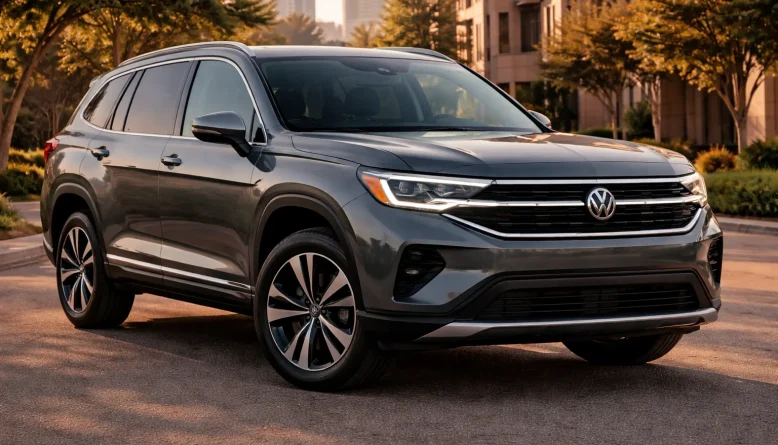
Three-row SUV buyers often reach a familiar impasse. Larger vehicles promise space and comfort, yet bring weight that affects fuel economy and responsiveness. Turbocharged engines offer usable power, but raise questions about long-term smoothness and operating costs. Interior technology can simplify daily driving, while also becoming a long-term reliability variable. The 2026 Volkswagen Atlas matters because it leans heavily into space and simplicity at a time when many rivals are chasing performance, hybridization, or complexity. Buyers cross-shopping it against other gas-powered SUVs want to know whether that straightforward approach still delivers value in real ownership.
Market Position and Purpose
The 2026 Volkswagen Atlas sits firmly in the mainstream midsize three-row SUV segment. It competes directly with models such as the Toyota Grand Highlander, Honda Pilot, Chevrolet Traverse, and Ford Explorer. Pricing historically positions the Atlas competitively, often undercutting similarly sized rivals when comparably equipped.
From a product-planning standpoint, the Atlas exists to maximize interior space and ease of use rather than efficiency or performance leadership. Volkswagen targets families who prioritize passenger room, simple controls, and predictable behavior over sporty driving dynamics or advanced powertrains.
What’s New
Volkswagen has not released confirmed, model-year-specific changes for the 2026 Volkswagen Atlas at the time of writing. The most recent significant update came with the Atlas refresh, which introduced a revised interior, updated infotainment system, and a streamlined powertrain lineup centered around a turbocharged four-cylinder engine. If the 2026 model carries over unchanged, buyers should not expect material improvements in performance or efficiency beyond what is already established.
The Exterior
The Atlas’ exterior design reflects its mission clearly. Proportions are boxy and upright, which benefits interior volume and visibility. The large glass area improves outward sightlines, a practical advantage in daily driving and parking situations.
Ride height makes ingress and egress easy for adults and children alike. Wheel and tire sizes vary by trim, with larger wheels affecting ride comfort more than appearance. Aerodynamics are not a focus, and that choice shows up more in fuel economy than in usability.
Real-World Driving Experience
In everyday driving, the Atlas feels calm and predictable rather than engaging. Throttle response from the turbocharged engine is tuned to be smooth at low speeds, which helps in traffic and parking lots. Initial acceleration can feel soft until boost builds, particularly with a full load of passengers.
The automatic transmission prioritizes smooth shifts over quick responses. Steering is light and easy to manage, though feedback is minimal. Ride quality is compliant, absorbing rough pavement well, but body motions are noticeable during quick lane changes or cornering. Braking remains consistent, with a stable pedal feel suited to family use.
Performance
The current Atlas uses a turbocharged 2.0-liter four-cylinder engine producing 269 horsepower. In real-world conditions, performance is adequate rather than strong. Highway merging and passing require planning, especially when the vehicle is loaded or driving at elevation.
Compared with V6-powered rivals, the Atlas feels less confident under sustained acceleration. However, for typical commuting and family errands, performance meets expectations without feeling strained.
Powertrain Behavior and Efficiency in Daily Use
EPA fuel economy ratings for the Atlas typically land in the low-20-mpg combined range, depending on drivetrain. In practice, real-world results often fall slightly below those figures, particularly in city driving where vehicle weight and turbo lag become more apparent.
On the highway, efficiency stabilizes, but the Atlas does not deliver standout mileage. Powertrain behavior remains consistent and predictable, which matters more to many owners than chasing marginal gains.
Interior Design, Ergonomics, and Vehicle-Specific Technology
Interior space is the Atlas’ defining trait. Seating comfort is good in the first two rows, and the third row stands out for adult-friendly legroom. The driving position is upright, with excellent forward visibility.
Control layout emphasizes simplicity. Physical controls remain for key functions, reducing reliance on touchscreens while driving. Materials quality varies by trim, ranging from durable surfaces to more refined finishes in higher trims. Overall, the interior favors function over flair.
Infotainment and Technology
Volkswagen’s infotainment system is responsive and visually clean following recent updates. Menu logic is straightforward, and smartphone integration works reliably, which reduces dependence on built-in navigation. Voice controls handle basic commands adequately. Long-term owner feedback has pointed to improved system stability compared with earlier Volkswagen systems.
Driver Assistance and Safety
Standard driver assistance features include adaptive cruise control and lane-keeping assistance. In real-world use, adaptive cruise maintains smooth following distances, while lane-centering works best on clearly marked highways. In a vehicle this large, the systems are tuned conservatively, avoiding abrupt corrections. Braking behavior remains predictable and confidence inspiring.
Ride Comfort, Noise Levels, and Long-Distance Behavior
Ride comfort is a strong point for the Atlas. The suspension absorbs road imperfections well, especially on smaller wheels. At highway speeds, wind and tire noise are present but controlled. Engine noise becomes noticeable under heavy acceleration, but settles quickly once cruising.
On long trips, the spacious cabin and supportive seats help reduce fatigue. The Atlas favors relaxed cruising rather than engagement, which aligns with its family-oriented mission.
Practicality and Everyday SUV Ownership Scenarios
Cargo capacity is among the best in the segment. With the third row folded, the Atlas offers a wide, flat load floor that easily accommodates strollers, luggage, or home improvement supplies. Even with all rows in use, cargo space remains usable.
Ingress and egress are straightforward for all passengers. Daily commuting is manageable despite the vehicle’s size, though fuel stops are more frequent than with hybrid alternatives. Towing capability is adequate for light trailers, fitting typical family needs.
Trims, Options, and Pricing
Recent Atlas trims have included SE, SE with Technology, SEL, and SEL Premium R-Line. Pricing in recent model years has started in the mid-$30,000 range and extended into the upper-$40,000s when fully equipped. Official MSRP pricing for the 2026 Volkswagen Atlas has not yet been released and should be confirmed once Volkswagen publishes updated order guides.
Release Date
Volkswagen has not announced a confirmed release date for the 2026 Atlas. Availability is expected to follow Volkswagen’s standard model-year rollout schedule, but buyers should rely on official announcements rather than assumptions.
Comparison With Direct Gas-Powered SUV Competitors
Buyers typically cross-shop the Atlas with the Toyota Grand Highlander, Honda Pilot, Chevrolet Traverse, and Ford Explorer. Compared with the Pilot, the Atlas offers more third-row space but less powertrain refinement. Against the Traverse, it prioritizes interior usability over outright cargo volume. Compared with the Explorer, it trades performance for simplicity and space.
Strengths, Weaknesses, and SUV Ownership Trade-Offs
The Atlas excels in interior space, visibility, and ease of use. Its weaknesses include modest performance, average fuel economy, and limited driving engagement. Ownership trade-offs favor comfort and packaging over efficiency or excitement.
Conclusion and Buyer Guidance
The 2026 Volkswagen Atlas is best suited for buyers who prioritize interior room, straightforward controls, and predictable daily behavior over performance or efficiency leadership. It does not attempt to redefine the segment, but it delivers consistent, practical ownership for families who value space above all else. Buyers seeking stronger engines, better fuel economy, or more engaging driving dynamics may find better fits elsewhere, but for space-focused SUV ownership, the Atlas remains a rational and competitive choice.

No Responses Yet