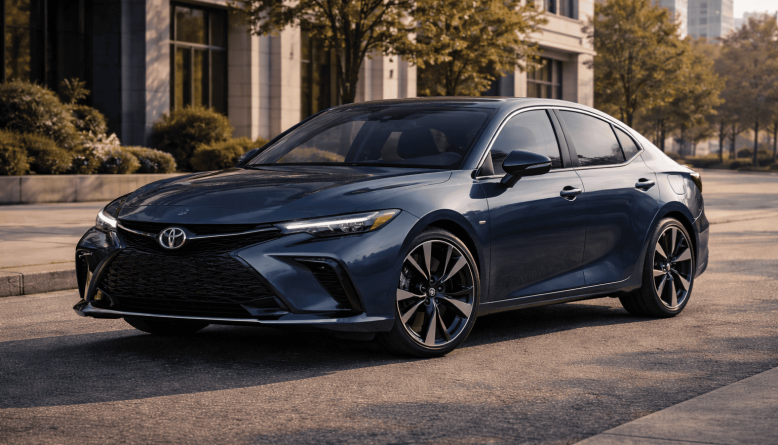
Hybrid sedan buyers are no longer asking whether electrification works. They want to know if it still makes financial and emotional sense. The 2026 Toyota Camry lands in a market where fuel savings are expected, reliability is assumed, and the real question is whether the hybrid premium still delivers value over years of ownership. For longtime Camry shoppers, this generation must prove it remains more than a safe habit.
Overview
The 2026 Toyota Camry continues its evolution as a hybrid-first mainstream sedan built around predictability and efficiency. It does not chase sport-sedan theatrics or tech overload. Instead, it doubles down on being easy to live with, easy to trust, and easy to recommend.
What’s New
For 2026, Toyota refines rather than reinvents. Calibration updates improve low-speed responsiveness, while minor software changes smooth hybrid transitions further. Feature availability shifts slightly by trim, reinforcing the Camry’s steady, incremental approach.
Exterior
Design changes remain subtle. The Camry’s shape looks cleaner and more resolved, with sharper lighting details that modernize its presence without alienating traditional buyers. It still prioritizes visibility and proportion over drama.
Interior
Inside, the cabin feels familiar in layout but improved in execution. Seating comfort remains a highlight, especially for long commutes. Rear-seat space continues to be generous, supporting real adult passengers without compromise.
Interior & Build Quality
Materials focus on durability rather than visual flair. Surfaces wear well, and controls feel robust. Over time, this restraint translates into fewer annoyances, which matters more than first impressions in daily ownership.
Infotainment & Technology – 2026 Toyota Camry
The infotainment system in the 2026 Toyota Camry emphasizes usability. Menus respond quickly, and physical buttons remain where they matter. This is technology designed to disappear into routine use rather than demand attention.
Powertrain / Hybrid System – 2026 Toyota Camry
Toyota’s hybrid system remains the Camry’s defining strength. EV-only driving engages smoothly in city traffic, and engine engagement feels natural rather than abrupt. The system prioritizes consistency over peak output, which suits its mission.
Performance
Acceleration is adequate and predictable. The Camry hybrid feels composed rather than eager, with steering tuned for stability instead of excitement. The added hybrid weight is well managed, preserving confidence through corners and highway merges.
Efficiency / MPG
Real-world fuel economy remains a strong point. In mixed driving, the Camry delivers consistent results that align closely with expectations. City driving benefits most, while highway efficiency stays competitive within the segment.
Driving Modes & Real-World Use
Driving modes subtly adjust throttle response and energy usage. Eco mode favors electric operation during urban driving, while normal mode feels best balanced for everyday use. The system adapts seamlessly without driver micromanagement.
Safety
The Camry feels secure in sudden maneuvers. Braking response is progressive, and chassis behavior remains predictable. Safety engineering focuses on stability and prevention rather than aggressive intervention.
Driver Assistance
Driver assistance features operate calmly. Adaptive cruise control and lane-centering functions reduce fatigue without constant alerts or abrupt corrections. Over time, this restraint builds driver confidence rather than frustration.
Trims, Options & Pricing
Pricing details for the 2026 Toyota Camry have not been fully finalized. Historically, Toyota positions the Camry competitively, with hybrid trims offering strong value relative to fuel savings and standard safety equipment.
Release Date
Toyota has not confirmed a specific release date for the 2026 Toyota Camry. Based on prior cycles, it is expected to arrive later in early 2026. No official month or quarter has been announced.
Key Pros & Cons
Ownership advantages include excellent real-world fuel economy, smooth hybrid operation, strong long-term reliability expectations, spacious interior comfort, intuitive controls, and high resale confidence.
Ownership drawbacks include conservative driving dynamics, restrained interior design, limited emotional appeal, modest performance compared to sportier rivals, pricing that rises with higher trims, and fewer customization options.
Competitors / Rivals
Key competitors include the Honda Accord Hybrid, Hyundai Sonata Hybrid, and Kia K5 Hybrid. Each offers unique strengths, but the Camry remains the benchmark for reliability-driven hybrid ownership.
Final Verdict
The 2026 Toyota Camry does not try to surprise its buyer, and that remains its greatest strength. It delivers dependable efficiency, smooth daily operation, and ownership confidence built on decades of consistency. For buyers who value predictability and long-term peace of mind over novelty, the Camry continues to justify its reputation as the smart hybrid choice.

No Responses Yet