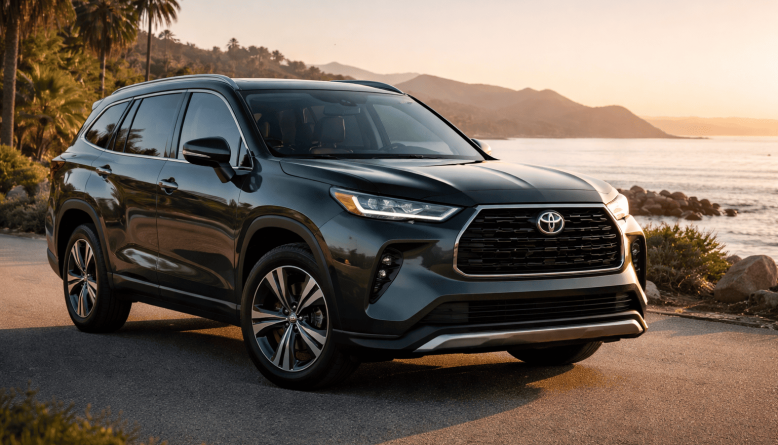
Hybrid SUVs have reached a point where buyers are no longer asking whether the technology works, but whether it still justifies the premium over a conventional gas model. With the 2026 Toyota Highlander Hybrid, the core dilemma centers on consistency rather than novelty: does the fuel economy advantage hold up in real-world use, and does the hybrid system meaningfully change how the Highlander feels to live with compared to the gas-only version? For buyers weighing long-term ownership costs, resale confidence, and everyday drivability against alternatives like the gas Highlander or competing hybrids, this question matters more now than ever.
Market Position and Hybrid Purpose
The 2026 Toyota Highlander Hybrid sits squarely in the mainstream three-row midsize SUV segment, targeting buyers who prioritize predictable ownership costs and fuel efficiency over outright performance. Pricing for the hybrid continues to carry a measurable premium over the gas-only Highlander, though that gap has narrowed in recent years as hybrids have become normalized within Toyota’s lineup. The hybrid exists not as a halo option, but as a volume play designed to appeal to high-mileage families, commuters with regular highway use, and owners planning to keep the vehicle beyond the warranty period.
From a product-planning perspective, the hybrid’s role is straightforward. It allows Toyota to offer materially better fuel efficiency without sacrificing AWD availability or interior packaging, while reinforcing the brand’s long-standing reputation for hybrid durability. Buyers cross-shopping rivals like the Ford Explorer Hybrid or Toyota’s own Grand Highlander Hybrid are often less concerned with acceleration metrics and more focused on whether the efficiency gains show up consistently in daily use.
What’s New
As of this writing, Toyota has not confirmed significant mechanical changes for the 2026 model year Highlander Hybrid. The powertrain remains the familiar 2.5-liter four-cylinder paired with Toyota’s latest-generation hybrid system and an electronically controlled AWD setup on AWD trims. Feature packaging and trim availability are expected to mirror recent model years, though final equipment changes have not been fully disclosed.
For buyers, the lack of major updates is not necessarily a drawback. The current hybrid system has been in service long enough to establish a strong reliability record, and stability year over year tends to benefit resale values and long-term confidence rather than undermine them.
The Exterior
From an ownership standpoint, the Highlander Hybrid’s exterior design prioritizes usability over flair. The proportions are conservative, but visibility remains good by modern SUV standards, particularly compared to more aggressively styled competitors. The hood line stays relatively low, which helps with front-end placement in tight parking situations.
Wheel and tire choices vary by trim, but Toyota generally avoids overly aggressive low-profile setups on the hybrid, which benefits ride quality and reduces replacement costs. Aerodynamic tweaks specific to the hybrid are subtle and do not meaningfully affect daily use, but they contribute incrementally to highway efficiency without introducing visual compromises.
Real-World Driving Experience
In everyday driving, the 2026 Toyota Highlander Hybrid feels immediately familiar to anyone who has driven a recent Toyota hybrid. Low-speed electric operation is smooth and predictable, particularly in parking lots and stop-and-go traffic. Throttle blending between electric and gas power is well managed, with fewer abrupt transitions than some competitors.
Regenerative braking remains a point of adjustment for new owners. Initial pedal feel is softer than a conventional braking system, though modulation improves once acclimated. Steering calibration favors stability over feedback, which suits the Highlander’s family-oriented mission, while ride quality remains composed over broken pavement without feeling floaty at highway speeds.
Performance
Performance in the Highlander Hybrid is adequate rather than engaging. Acceleration is sufficient for merging and passing, but it lacks the immediate punch of turbocharged gas rivals. That said, the electric motor’s torque fill helps reduce hesitation at lower speeds, making the vehicle feel more responsive around town than its horsepower figures might suggest.
Compared to the gas-only Highlander, the hybrid prioritizes smoothness over urgency. Buyers expecting a sportier character may find it subdued, but those focused on predictable, low-stress driving will likely view this as a strength.
Hybrid Powertrain Performance and Efficiency in Daily Use
The hybrid system’s real advantage emerges in mixed driving. While EPA ratings remain a useful baseline, real-world efficiency tends to be most impressive in suburban and urban conditions where regenerative braking and electric assist are used frequently. Highway efficiency remains solid, though the gap narrows compared to the gas model at sustained high speeds.
Importantly, efficiency consistency is one of the Highlander Hybrid’s strongest attributes. Owners are less likely to see dramatic swings in fuel economy due to driving style than with some plug-in or turbocharged alternatives. Over time, this predictability simplifies budgeting and reinforces the hybrid’s value proposition.
Interior Design, Ergonomics, and Hybrid-Specific Technology
Inside, the Highlander Hybrid emphasizes clarity and ease of use. Seating comfort is tuned for long trips, with supportive cushions and a driving position that accommodates a wide range of body types. Controls remain logically arranged, and physical buttons are retained for key functions, reducing distraction.
Hybrid-specific displays provide real-time energy flow and efficiency data, but they remain secondary rather than intrusive. Drivers can monitor system behavior without feeling compelled to micromanage it, which aligns well with the Highlander’s overall character.
Infotainment and Technology
Toyota’s infotainment system continues to prioritize reliability over visual flash. Screen responsiveness is adequate, menu structures are straightforward, and wireless smartphone integration is available on most trims. While the interface lacks the graphical polish of some competitors, system stability and ease of use tend to matter more in daily ownership.
Long-term owners benefit from fewer software glitches and less reliance on touch-only controls, especially when driving on rough roads or in cold weather.
Driver Assistance and Safety
The 2026 Toyota Highlander Hybrid includes Toyota Safety Sense as standard equipment, offering adaptive cruise control, lane-centering assistance, and automated emergency braking. In real-world use, these systems are calibrated conservatively, favoring smooth interventions over aggressive corrections.
Lane-centering performs best on clearly marked highways, while adaptive cruise integrates seamlessly with the hybrid’s regenerative braking, maintaining consistent following distances without abrupt deceleration. This integration contributes to reduced driver fatigue on longer trips.
Ride Comfort, Noise Levels, and Long-Distance Behavior
Noise, vibration, and harshness levels remain well controlled across most driving scenarios. Electric operation at low speeds reduces urban noise, while the gas engine remains subdued during steady cruising. Under heavy load, engine sound becomes more noticeable, though it rarely feels intrusive.
Over extended highway drives, the Highlander Hybrid proves to be a comfortable long-distance companion. Seats remain supportive, and the suspension filters out expansion joints effectively, contributing to lower fatigue levels for both driver and passengers.
Practicality and Everyday Hybrid Ownership Scenarios
Cargo space remains competitive for the segment, with minimal intrusion from the hybrid battery pack. Third-row usability is adequate for children and shorter adults, though frequent adult use may still favor larger alternatives.
In daily ownership, the hybrid’s reduced refueling frequency becomes one of its most tangible benefits. Longer intervals between fill-ups simplify road trips and commuting routines, particularly for families juggling busy schedules.
Trims, Options, and Pricing
Toyota has not yet released final 2026 pricing for the Highlander Hybrid. Based on recent model years, buyers can expect multiple trims ranging from value-oriented to near-luxury configurations. Equipment differences typically center on interior materials, technology features, and wheel sizes rather than mechanical changes.
Until official pricing is announced, buyers should view the hybrid’s value primarily through total cost of ownership rather than upfront MSRP alone.
Release Date
Toyota has not formally announced a specific release date for the 2026 Highlander Hybrid. Based on historical product cycles, availability is expected to align with Toyota’s typical late-year rollout, though this remains unconfirmed.
Comparison With Direct Hybrid and Gas Competitors
Buyers often cross-shop the 2026 Toyota Highlander Hybrid against the gas Highlander, Ford Explorer Hybrid, and Toyota’s own Grand Highlander Hybrid. Compared to the gas model, the hybrid offers lower operating costs and smoother low-speed behavior at the expense of outright performance. Against the Explorer Hybrid, the Toyota emphasizes efficiency consistency and long-term reliability over power and towing capability.
Strengths, Weaknesses, and Hybrid Ownership Trade-Offs
The Highlander Hybrid’s strengths lie in predictability, efficiency consistency, and proven hybrid engineering. Its weaknesses center on modest performance and a driving experience that prioritizes calm over engagement. For owners who value reliability and low operating stress, these trade-offs are acceptable. For those seeking excitement or maximum towing capacity, they may not be.
Conclusion and Buyer Guidance
The 2026 Toyota Highlander Hybrid makes the most sense for buyers who value steady efficiency, long-term confidence, and low daily friction over outright performance or cutting-edge technology. It rewards consistent use rather than aggressive driving and fits naturally into family-focused ownership scenarios.
Buyers who prioritize acceleration or regularly tow heavy loads may find better alignment with gas-powered alternatives. However, for those planning to keep their vehicle for many years and rack up miles without surprises, the Highlander Hybrid remains one of the most rational choices in the segment.

No Responses Yet