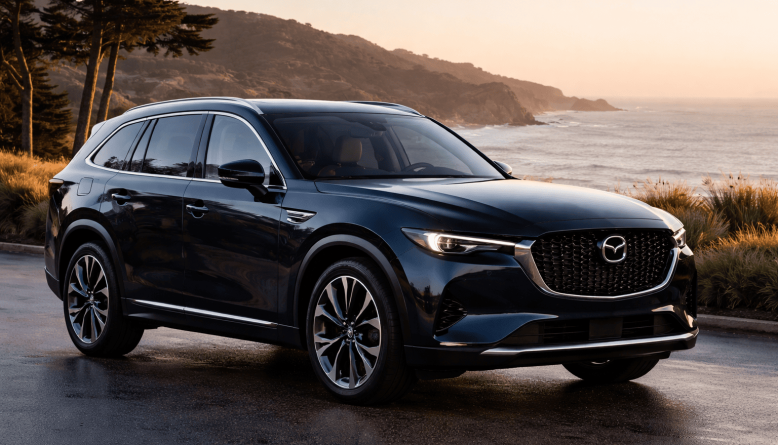
For buyers comparing hybrids in this size and price range, the dilemma usually starts with intent versus outcome. You may want better fuel efficiency without giving up driving engagement, or smoother daily behavior without accepting a disconnected feel. With the 2026 Mazda CX-90 Hybrid, the question is not whether it saves fuel compared with a conventional six-cylinder SUV, but whether the hybrid system meaningfully improves daily ownership without introducing friction in driving feel, long-term confidence, or usability. This matters now because midsize three-row hybrids are no longer novelties. Buyers expect them to feel cohesive, predictable, and durable, not experimental.
Mazda’s hybrid approach with the CX-90 is notably different from Toyota-style efficiency-first systems. That difference shows up quickly in how the vehicle drives, how it responds to inputs, and how it fits into real ownership patterns rather than spec-sheet comparisons.
Market Position and Hybrid Purpose
The 2026 Mazda CX-90 Hybrid sits in the premium-leaning end of the midsize three-row hybrid segment. It competes directly with vehicles like the Toyota Grand Highlander Hybrid and Volvo XC90 Recharge, while also pulling buyers away from gas-only luxury crossovers. Pricing remains higher than the base turbocharged CX-90, but not so far apart that it feels inaccessible to buyers already shopping well-equipped trims.
From a product-planning standpoint, this hybrid exists to preserve Mazda’s rear-wheel-drive-based platform while adding efficiency and torque smoothing rather than chasing maximum MPG. That shapes who it is for. The target buyer values steering feel, balanced chassis behavior, and restrained luxury more than absolute fuel savings. As a result, the 2026 Mazda CX-90 Hybrid prioritizes drivability consistency over aggressive electric-only operation.
What’s New
As of now, Mazda has not confirmed significant mechanical changes for the 2026 model year CX-90 Hybrid. The powertrain carries over with the same plug-in hybrid configuration, and no verified updates to battery capacity, electric range, or system output have been announced. This continuity matters because early CX-90 hybrids already established a clear behavioral character. Buyers should not expect recalibration that fundamentally alters how the hybrid system blends power.
Feature availability and trim packaging may see minor adjustments, but until Mazda releases official documentation, those details remain unconfirmed and should be treated cautiously.
The Exterior
The exterior design of the CX-90 emphasizes length and proportion rather than visual aggression. From an ownership perspective, the long hood and rear-wheel-drive proportions improve forward visibility judgment once acclimated, though initial parking maneuvers require attention due to the vehicle’s length.
Hybrid-specific exterior cues remain subtle, which benefits owners who prefer understated design. Wheel sizes vary by trim, and larger wheels do introduce slightly firmer ride characteristics on broken pavement. Aerodynamically, the design favors stability at highway speeds rather than maximum efficiency gains, which aligns with the vehicle’s driving priorities.
Real-World Driving Experience
At low speeds, the hybrid system allows brief electric-only movement, particularly in parking lots and stop-and-go traffic. Throttle blending is generally smooth, but not imperceptible. Drivers will notice engine engagement more than in Toyota-style hybrids, though the transition feels deliberate rather than abrupt.
Regenerative braking is well integrated but firmer at the top of the pedal than some rivals. This creates predictable stopping behavior once familiar, but it lacks the soft initial bite some buyers prefer. Steering remains a CX-90 strength, with consistent weighting and better on-center feel than most three-row hybrids. Ride quality favors control over plushness, particularly at lower speeds over sharp impacts.
Performance
Acceleration in the 2026 Mazda CX-90 Hybrid feels immediate due to electric torque filling gaps in the power curve. Passing response at highway speeds is confident, especially compared with four-cylinder turbo competitors. However, outright acceleration is not its defining trait. Instead, power delivery feels linear and composed, which benefits real-world driving more than headline numbers.
Compared with the gas-only inline-six CX-90, the hybrid sacrifices some auditory refinement under load but gains smoother low-speed response.
Hybrid Powertrain Performance and Efficiency in Daily Use
In mixed driving, the hybrid system prioritizes torque assistance rather than sustained electric operation. EPA figures translate reasonably well in suburban use, though highway-heavy drivers will see less dramatic gains. Efficiency consistency remains solid as long as driving patterns include frequent deceleration opportunities for regeneration.
Owners expecting the vehicle to behave like a traditional efficiency-maximizing hybrid may feel underwhelmed. Those who understand its engineering intent will find the system predictable and stable over time.
Interior Design, Ergonomics, and Hybrid-Specific Technology
The interior reflects Mazda’s move upmarket. Seating comfort is firm but supportive, particularly for front occupants. Control layout favors physical interfaces, which reduces distraction and improves usability over long ownership.
Hybrid-specific displays provide energy flow information without overwhelming the driver. Mazda avoids gamification, which suits buyers focused on driving rather than efficiency monitoring.
Infotainment and Technology
Mazda’s infotainment system prioritizes rotary control over touch interaction. Screen resolution and responsiveness are adequate, though not class-leading. Smartphone integration works reliably, but menu depth can require familiarization. System stability has been generally strong in existing models, with fewer reported glitches than some competitors.
Driver Assistance and Safety
Standard driver assistance features include adaptive cruise control and lane-keeping support. Lane-centering behavior feels natural and avoids aggressive corrections, which works well with the CX-90’s chassis tuning. Adaptive cruise integrates smoothly with regenerative braking, maintaining predictable deceleration without sudden handoffs.
Ride Comfort, Noise Levels, and Long-Distance Behavior
On extended highway drives, the CX-90 Hybrid remains composed and stable. Road noise is well controlled, though coarse pavement can transmit more sound than in softer-riding competitors. Engine cycling at cruising speeds is noticeable but subdued. Fatigue levels remain low thanks to supportive seats and consistent steering response.
Practicality and Everyday Hybrid Ownership Scenarios
Cargo space remains competitive, though battery placement slightly reduces underfloor storage flexibility. Third-row access is acceptable but not class-leading. For daily commuting, the hybrid system reduces fuel stops modestly rather than dramatically. Road trip confidence remains strong due to traditional refueling rather than reliance on charging infrastructure.
Trims, Options, and Pricing
Verified MSRP figures for the 2026 model year have not yet been released. Based on current structure, the hybrid remains available in higher trims, which raises entry cost but bundles desirable equipment. Buyers should monitor official pricing announcements before assuming carryover figures.
Release Date
Mazda has not officially confirmed the release date for the 2026 Mazda CX-90 Hybrid. Historically, updates arrive late in the calendar year, but no verified timeline has been announced.
Comparison With Direct Hybrid and Gas Competitors
Against the Toyota Grand Highlander Hybrid, the CX-90 Hybrid offers superior steering feel and chassis balance but trails in absolute efficiency. Compared with the Volvo XC90 Recharge, it delivers a more engaging drive at a lower price point, though with less electric-only capability. Gas-powered alternatives may appeal to buyers prioritizing simplicity over electrified complexity.
Strengths, Weaknesses, and Hybrid Ownership Trade-Offs
The hybrid system enhances drivability rather than transforming efficiency. Strengths include balanced handling, consistent steering, and restrained interior design. Weaknesses center on limited electric-only operation and efficiency that depends heavily on driving conditions. Ownership trade-offs favor engagement over maximum savings.
Conclusion and Buyer Guidance
The 2026 Mazda CX-90 Hybrid makes sense for buyers who want a three-row hybrid that still feels engineered around driving rather than optimization algorithms. It rewards those who value steering feedback, composure, and predictable behavior over headline MPG figures. Buyers seeking the most dramatic fuel savings or extended electric operation may be better served elsewhere. For drivers who want a hybrid that feels cohesive and intentional in daily life, this Mazda delivers a clear, honest proposition.


No Responses Yet