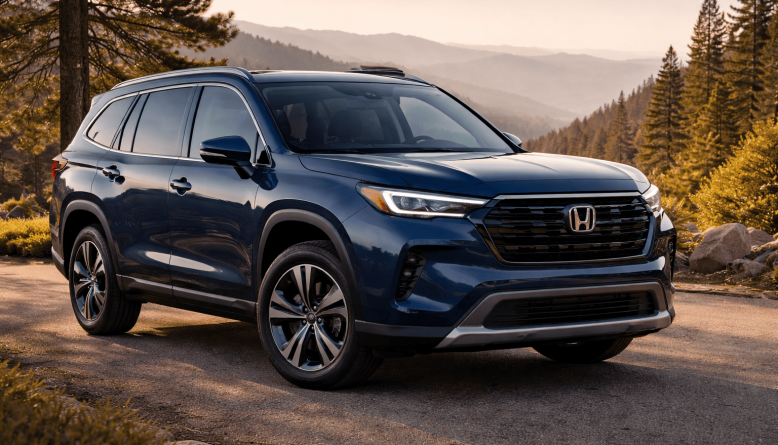
The central dilemma facing a serious three-row buyer today is familiar: choosing between long-term reliability and everyday comfort versus newer rivals offering more screens, turbocharged powertrains, or hybrid efficiency. A 2026 Honda Pilot ownership review for families and daily use has to start there, because most shoppers considering the 2026 Honda Pilot are not chasing novelty. They are cross-shopping vehicles like the Toyota Grand Highlander, Kia Telluride, and Mazda CX-90 while asking a quieter question about durability, usability, and how the vehicle will feel after several years of routine family duty rather than during a brief test drive.
Market Position and Purpose
The Honda Pilot occupies the conservative, ownership-focused end of the midsize three-row SUV segment. Its role within Honda’s lineup is to provide a naturally aspirated, V6-powered alternative to increasingly complex turbocharged and hybrid competitors. From a product-planning standpoint, the Pilot exists to serve buyers who value predictable mechanical behavior, stable resale, and low learning curves over cutting-edge powertrain experimentation. In daily ownership terms, it is designed to be easy to live with rather than exciting to explain.
What’s New
As of this writing, Honda has not released confirmed details about changes specific to the 2026 model year Pilot. The current-generation Honda Pilot was fully redesigned for the 2023 model year, and subsequent updates through 2025 have been incremental rather than structural. Any discussion of 2026 changes beyond that is unconfirmed, and Honda has not announced new powertrains, interior revisions, or technology overhauls for this model year.
Exterior and Daily Usability
The current-generation Pilot’s exterior prioritizes visibility and functional proportions over stylized aerodynamics. The hood line is relatively flat, the glass area is generous for the segment, and the upright body reduces blind spots in parking lots and school drop-off lines. Wheel and tire sizes vary by trim, but Honda has avoided ultra-low-profile fitments that would compromise ride comfort or replacement cost. In daily use, the boxier shape pays dividends when loading bulky items or fitting child seats, even if it sacrifices some visual drama compared to sleeker rivals.
Real-World Driving Experience
In everyday driving, the Pilot emphasizes consistency rather than engagement. Throttle response from the naturally aspirated V6 is linear, with no turbo lag or artificial tuning spikes. Steering calibration is light at low speeds and predictable on-center, which suits urban and suburban use but offers limited feedback on winding roads. Ride quality remains one of the Pilot’s strengths, absorbing broken pavement without excessive float, and braking behavior is stable and progressive in routine traffic.
Performance in Everyday Conditions
Usable performance is where the Pilot quietly makes its case. The 3.5-liter V6, producing 285 horsepower in current verified specifications, delivers confident merging and highway passing without requiring aggressive throttle inputs. Sustained highway speeds are handled without strain, and the 10-speed automatic transmission prioritizes smoothness over rapid downshifts. For daily commuting and family travel, the Pilot feels appropriately powered rather than overworked.
Powertrain Behavior and Efficiency in Daily Use
Based on the latest confirmed EPA ratings for the current-generation Honda Pilot, front-wheel-drive models are rated at 19 mpg city and 27 mpg highway, while all-wheel-drive versions are rated slightly lower. In real-world ownership, these figures tend to translate into low-20s combined fuel economy when driven conservatively, with noticeable drops during short trips and heavy loading. Honda has not announced any hybrid or electrified alternative for the 2026 Pilot, and no battery capacity or charging data applies.
Interior Design and Ergonomics
Interior design favors clarity over visual experimentation. Controls are logically placed, sightlines are clean, and seat comfort remains a Pilot strong point, especially over longer distances. Material quality improves as trims rise, but even lower trims prioritize durability over softness. From an ownership perspective, the interior feels designed to age slowly rather than impress immediately, which aligns with long-term family use.
Infotainment and Software
Infotainment hardware varies by trim, with a smaller central display on base models and a larger touchscreen on higher trims. Wireless Apple CarPlay and Android Auto are available on upper trims in current verified configurations. Menu logic is straightforward, response times are acceptable rather than class-leading, and system stability has generally been stronger than some newer, more complex competitor interfaces. For owners, the system favors reliability over customization.
Driver Assistance and Safety Behavior
Honda Sensing driver assistance features are standard across the lineup based on current verified data. In real driving, adaptive cruise control and lane-keeping assistance behave conservatively, with gradual interventions rather than abrupt corrections. The systems are tuned to support rather than replace attentive driving, which reduces fatigue on longer trips without creating overreliance or frustration.
Ride Comfort, Noise, and Long-Distance Use
Noise, vibration, and harshness are well-controlled for a vehicle of this size. Road noise is present on coarse surfaces but remains consistent rather than intrusive. Wind noise stays low at highway speeds, and seat support reduces fatigue over multi-hour drives. For families who regularly cover long distances, the Pilot’s calm demeanor becomes more valuable over time than its lack of sportiness.
Ownership Costs and Practicality
Practicality remains central to the Pilot’s appeal. Interior storage is thoughtfully distributed, third-row access is straightforward, and cargo space is competitive when seats are folded. Maintenance expectations are aligned with Honda’s traditional service intervals, and the naturally aspirated engine avoids the added complexity of turbocharged systems. From a daily ownership standpoint, the Pilot favors predictability in both costs and usability.
Trims, Options, and Pricing
Verified trims for the current-generation Honda Pilot include Sport, EX-L, Touring, TrailSport, Elite, and Black Edition. As of now, Honda has not announced official 2026 pricing or equipment changes. For context only, 2025 Pilot MSRP in the U.S. market ranged from the high $30,000s to the low $50,000s depending on trim and drivetrain, but 2026 pricing should be considered unconfirmed until Honda releases official figures.
Release Timing
Honda has not formally announced the release timing for the 2026 Honda Pilot. Historically, Pilot model years arrive in the U.S. market in the second half of the preceding calendar year, but no confirmed schedule has been published for this cycle.
Comparison With Direct Competitors
In ownership-focused comparisons, the Pilot competes most directly with the Toyota Grand Highlander, Kia Telluride, and Mazda CX-90. The Toyota offers hybrid efficiency but with added drivetrain complexity. The Kia emphasizes interior presentation and features but carries different long-term reliability perceptions. The Mazda delivers a more engaging driving experience but sacrifices some interior space. The Pilot’s advantage lies in balanced competence rather than dominance in any single category.
Strengths, Weaknesses, and Trade-Offs
The Pilot’s strengths center on mechanical simplicity, predictable driving behavior, and long-term usability. Its weaknesses include modest fuel economy compared to hybrid rivals and infotainment technology that feels conservative rather than forward-looking. The trade-off is clear: buyers give up cutting-edge features in exchange for a vehicle that is easier to live with year after year.
Conclusion and Buyer Guidance
The 2026 Honda Pilot is best suited for families and daily drivers who prioritize reliability, comfort, and straightforward ownership over novelty or maximum efficiency. It rewards buyers who plan to keep their vehicle beyond the warranty period and value consistent behavior in real-world conditions. Shoppers seeking hybrid fuel savings, sharper handling, or the latest interface design should look elsewhere, but for measured, long-term ownership, the Pilot remains a rational and defensible choice.


No Responses Yet