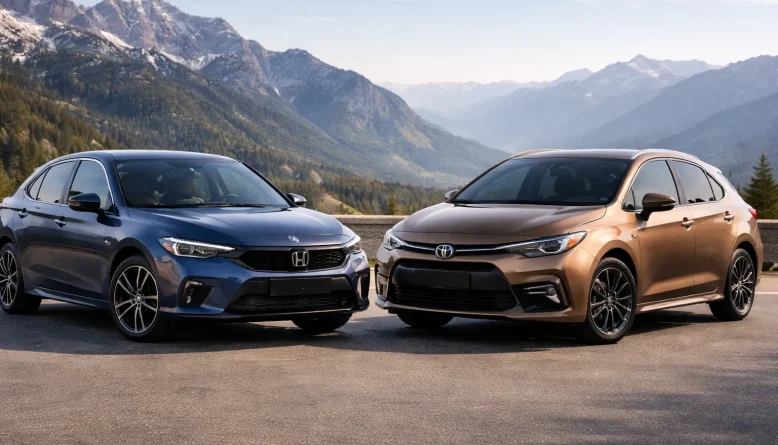
The 2024 Honda Civic vs Toyota Corolla buyer guide is about choosing between two compact sedans that define sensible, long-term car ownership. Both target buyers who value efficiency, reliability, and predictable costs, yet they differ in driving character, interior execution, and how they age over years of use. For shoppers cross-shopping alternatives, this comparison matters because these cars often stay in a household longer than planned, making day-to-day livability more important than headline specs.
Buyer Context and Market Positioning
Buyers comparing the 2024 Honda Civic vs Toyota Corolla are typically first-time new-car buyers, downsizers, or owners replacing an older compact sedan. This is a classic Car A vs Car B decision in the global compact car segment, where practicality and total cost of ownership outweigh novelty.
The Civic positions itself as the more driver-focused option, even in non-sport trims. The Corolla emphasizes efficiency, ease of use, and a long-standing reputation for reliability. When asking which should you buy, the answer usually depends on whether driving engagement or low-effort ownership matters more to you.
Both models compete directly in the USA, Canada, Europe, and other global markets, though body styles and powertrain availability vary slightly by region.
Pricing, Trims, and Real-World Value
In the United States, the 2024 Honda Civic sedan starts in the mid-$20,000 range, while the 2024 Toyota Corolla undercuts it slightly at entry level. Pricing differences narrow quickly as you move into higher trims. Canadian and European pricing follows similar positioning after regional adjustments.
At comparable price points, the Civic often includes more standard comfort and convenience features, while the Corolla emphasizes value through efficiency and safety technology. Toyota’s hybrid Corolla is a major differentiator, offering significantly lower fuel consumption at a modest price premium.
Trim strategies differ in philosophy. Honda keeps the Civic lineup relatively streamlined, which simplifies decisions but limits customization. Toyota offers a wider trim spread, especially when factoring in hybrid variants, which gives buyers more choice but adds complexity.
Powertrain, Performance, and Efficiency
Powertrain offerings define much of the 2024 Honda Civic vs Toyota Corolla buyer guide. The Civic uses a naturally aspirated 2.0-liter four-cylinder engine in most trims, paired with a continuously variable transmission. Performance is adequate for daily driving, with smooth acceleration and predictable response in traffic.
The Corolla also uses a naturally aspirated four-cylinder engine with a CVT, tuned for efficiency rather than urgency. In city driving, the Corolla feels relaxed and easygoing, though highway passing requires planning. The Corolla Hybrid stands apart, delivering significantly higher fuel economy, particularly in stop-and-go conditions.
In real-world use, the Civic feels more responsive during highway merging and lane changes, while the Corolla prioritizes smoothness and fuel savings. Official fuel economy ratings favor the Corolla, especially in hybrid form, though driving style plays a meaningful role.
Ride Quality, Handling, and Driving Character
Ride quality differences emerge quickly. The Civic feels more planted and composed at speed, with steering that provides clearer feedback than most cars in the segment. Body control is well managed, and the car feels confident on winding roads.
The Corolla favors comfort and predictability. Its suspension absorbs rough pavement effectively at low speeds, though body movements are more noticeable during quick transitions. Steering is lighter and less communicative, which suits relaxed commuting.
On the highway, both cars are stable, though the Civic feels more settled over long distances. Buyers sensitive to road feel will likely prefer the Honda, while those seeking an easygoing drive may lean toward the Toyota.
Interior Quality, Comfort, and Usability
Interior execution reflects each brand’s priorities. The Civic features a clean, modern cabin with intuitive controls and strong material quality for the class. Seating comfort is excellent, and the driving position feels natural, even on long trips.
The Corolla interior is functional and durable, though less visually cohesive. Materials are competitive but lean more toward longevity than design flair. Front-seat comfort is good, though rear-seat space feels slightly tighter than in the Civic.
Cabin noise levels favor the Civic at highway speeds, where better insulation contributes to a calmer environment. Visibility is good in both, though the Civic’s lower beltline improves outward sightlines.
Infotainment, Technology, and Driver Assistance
Both models offer modern infotainment systems with standard smartphone integration. Screen sizes are adequate, and responsiveness is acceptable, though Honda’s interface feels slightly more intuitive.
Driver assistance systems are standard across most trims, including adaptive cruise control, lane-keeping assistance, and automatic emergency braking. Toyota’s systems tend to intervene earlier, while Honda’s feel more natural once calibrated.
In daily use, both systems enhance safety without dramatically changing the driving experience, though sensitivity settings may require adjustment.
Space, Practicality, and Daily Use
The Civic offers more rear-seat legroom and a slightly larger trunk, making it better suited for frequent passengers or occasional road trips. Cargo loading is straightforward, and rear-seat access is easy.
The Corolla remains practical for daily errands and commuting, though rear-seat space is more limited. For single drivers or couples, this is rarely an issue.
Both vehicles support child-seat installation well, though families may appreciate the Civic’s added space margin.
Safety and Reliability Considerations
Both the Civic and Corolla have strong safety reputations and earn high crash-test ratings where evaluated. Standard safety equipment is comprehensive on both models.
Reliability trends historically favor both brands, with Toyota maintaining a slight edge in long-term durability metrics. Warranty coverage is similar and typical for the segment.
Ownership Costs and Long-Term Perspective
Fuel costs favor the Corolla, particularly the hybrid, making it attractive for high-mileage drivers. Maintenance costs are low for both, with widespread dealer networks supporting ownership globally.
Depreciation trends slightly favor the Corolla, reflecting Toyota’s reputation for longevity. The Civic remains competitive, particularly in markets where demand stays strong.
Verdict: Which Buyer Should Choose Which Car
The 2024 Honda Civic vs Toyota Corolla buyer guide does not produce a universal answer. Buyers who value driving feel, interior refinement, and balanced performance will likely prefer the Civic. It suits owners who want their daily commute to feel engaging without sacrificing practicality.
The Corolla is the better choice for buyers focused on fuel efficiency, long-term reliability, and minimal ownership effort. It works best for those who see their car as a dependable tool rather than a driving experience.
Both deliver on their promises. The right choice depends on whether engagement or efficiency defines your priorities.

No Responses Yet