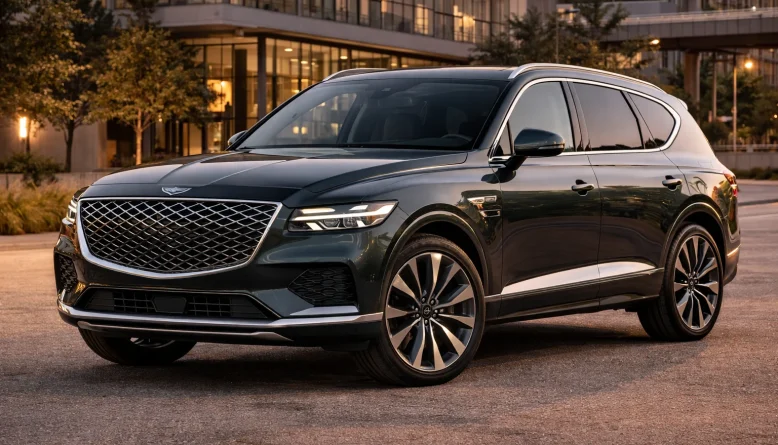
For buyers considering a full-size luxury SUV hybrid, the dilemma often starts before the test drive. The promise of lower fuel consumption and smoother operation sounds appealing, yet the risk lies in paying a premium for a powertrain that may not meaningfully change daily ownership. With the 2026 Genesis GV80 Hybrid, that tension is amplified because buyers are weighing not only hybrid trade-offs, but also uncertainty around availability, configuration, and long-term support. In a segment where alternatives from Lexus, BMW, and Volvo already offer established hybrid systems, the question is whether Genesis’ approach, if and when it arrives, would materially improve ownership over the existing gas-powered GV80.
Market Position and Hybrid Purpose
As of now, the 2026 Genesis GV80 Hybrid has not been officially confirmed by Genesis for the U.S. market. The current GV80 lineup relies on turbocharged gasoline engines with mild-hybrid assistance rather than a full hybrid or plug-in hybrid system. From a market-position standpoint, a true hybrid GV80 would likely sit above the standard 2.5T and 3.5T gas models in pricing, targeting buyers who want reduced fuel consumption without downsizing or moving to a different brand.
If introduced, its purpose would likely mirror competitors: offering incremental efficiency and potentially smoother low-speed operation in a large, comfort-focused SUV. Until Genesis confirms such a model, buyers should treat the 2026 Genesis GV80 Hybrid as speculative rather than a concrete alternative.
What’s New
There are currently no verified announcements, specifications, or regulatory filings confirming a hybrid version of the GV80 for the 2026 model year. No data exists on battery size, electric motor output, system architecture, or trim availability. This absence matters because hybrid ownership decisions depend heavily on proven hardware, not concepts or expectations. Buyers should base decisions on the existing gas GV80 until Genesis releases official information.
The Exterior
Without a confirmed hybrid model, exterior considerations remain hypothetical. The current GV80 design emphasizes long hood proportions, a wide stance, and excellent road presence. If a hybrid were introduced, it would likely share the same exterior with minimal differentiation, as Genesis tends to avoid overt hybrid styling cues. Visibility, parking ease, and wheel sizing would likely remain unchanged, preserving daily usability but offering no hybrid-specific ownership advantages.
Real-World Driving Experience
Because a true GV80 hybrid has not been verified, real-world driving behavior cannot be assessed. The existing mild-hybrid gas models prioritize smoothness and isolation, with electric assistance limited to start-stop refinement rather than propulsion. Any claims about electric-only driving, regenerative braking feel, or throttle blending for the 2026 Genesis GV80 Hybrid would be speculative and are therefore inappropriate to assume.
Performance
Performance data for a GV80 hybrid does not exist at this time. Current GV80 models offer strong acceleration from turbocharged gasoline engines, particularly the 3.5T. A future hybrid could potentially improve low-speed torque delivery, but without verified output figures, buyers should not expect meaningful performance gains relative to the gas models.
Hybrid Powertrain Performance and Efficiency in Daily Use
No EPA ratings, real-world efficiency data, or system descriptions are available for a GV80 hybrid. This is critical, because large luxury SUVs often see diminishing returns from hybridization once weight and packaging constraints are factored in. Until Genesis confirms how a hybrid system would behave in traffic, on highways, and under load, ownership expectations cannot be responsibly defined.
Interior Design, Ergonomics, and Hybrid-Specific Technology
The current GV80 interior sets a high bar for materials quality, seating comfort, and noise isolation. A hybrid version would likely retain this cabin architecture. However, there is no confirmed information on hybrid-specific displays, energy management screens, or changes to storage space due to battery packaging. These factors directly affect ownership satisfaction and cannot be inferred without data.
Infotainment and Technology
Genesis’ infotainment system is already well regarded for clarity and stability. There is no evidence suggesting a hybrid GV80 would introduce unique infotainment features beyond potential energy-use displays. Until confirmed, buyers should assume no meaningful change from the existing system.
Driver Assistance and Safety
Driver assistance features in the GV80 are comprehensive and well tuned for comfort-focused driving. There is no indication that a hybrid variant would alter calibration, capability, or availability. No safety data specific to a hybrid GV80 exists.
Ride Comfort, Noise Levels, and Long-Distance Behavior
The GV80’s strength lies in ride comfort and low noise levels. A hybrid system could theoretically improve low-speed quietness while adding weight that affects ride tuning. Without a confirmed model, it is impossible to assess whether long-distance comfort would improve or degrade compared with the gas versions.
Practicality and Everyday Hybrid Ownership Scenarios
Battery packaging is often the hidden cost of hybrid ownership in large SUVs. Without verified information, cargo space, third-row usability, and underfloor storage impacts remain unknown. This uncertainty alone is a meaningful ownership consideration for family buyers.
Trims, Options, and Pricing
Genesis has not released any pricing, trim names, or option structures for a 2026 Genesis GV80 Hybrid. Based on segment norms, pricing would almost certainly exceed that of gas models. However, without official MSRP data, no conclusions can be responsibly drawn.
Release Date
There is no confirmed release date for a GV80 hybrid. Genesis has not publicly committed to offering a hybrid version of the GV80 for the 2026 model year in the U.S. market.
Comparison With Direct Hybrid and Gas Competitors
In practice, buyers cross-shopping a hypothetical GV80 hybrid are currently comparing real alternatives such as the Lexus TX 500h+, Volvo XC90 Hybrid, and BMW X5 xDrive50e. Each of those models offers verified hybrid systems, known efficiency behavior, and established ownership data. Until Genesis confirms a GV80 hybrid, it remains at a disadvantage in this comparison.
Strengths, Weaknesses, and Hybrid Ownership Trade-Offs
At this stage, the primary weakness of the 2026 Genesis GV80 Hybrid is uncertainty. Without confirmed hardware, buyers cannot assess reliability, efficiency consistency, or value. The potential strength would be Genesis’ strong interior execution and ride comfort, assuming those traits carry over unchanged.
Conclusion and Buyer Guidance
The 2026 Genesis GV80 Hybrid remains an unanswered question rather than a defined product. For buyers who need a hybrid SUV today, established alternatives offer clearer ownership outcomes and lower risk. Unless and until Genesis confirms specifications, pricing, and availability, buyers interested in hybrid ownership are better served choosing a verified hybrid model or sticking with the proven gas-powered GV80.

No Responses Yet