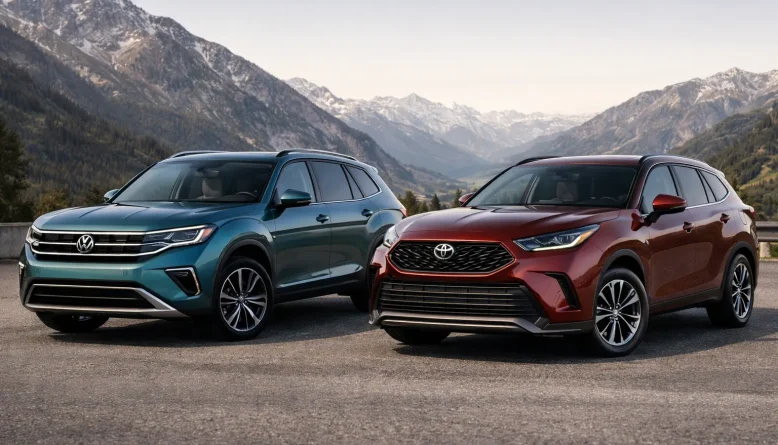
The 2024 Volkswagen Atlas vs Toyota Highlander comparison centers on two three-row midsize SUVs that approach family ownership from very different priorities. Both target buyers who need space, safety, and long-term dependability, yet they diverge sharply in interior philosophy, powertrain strategy, and overall ownership character. For buyers actively cross-shopping alternatives, this comparison matters because these differences affect daily use far more than raw specifications.
Buyer Context and Market Positioning
Buyers considering the 2024 Volkswagen Atlas vs Toyota Highlander are typically families moving out of compact SUVs or replacing older three-row crossovers. This is a Car A vs Car B decision within the heart of the mainstream midsize SUV segment, where practicality and reliability often outweigh brand image.
The Atlas appeals to buyers who prioritize interior space, especially adult-friendly third-row seating, and straightforward usability. The Highlander targets buyers who value efficiency, long-term reliability reputation, and a more refined on-road feel. When asking which should you buy, the answer often depends on whether space or efficiency sits higher on your priority list.
Pricing, Trims, and Real-World Value
In the United States, the 2024 Volkswagen Atlas starts in the mid-$30,000 range, while the 2024 Toyota Highlander begins slightly higher, depending on drivetrain. Canadian and European pricing structures follow similar relative positioning, adjusted for market-specific taxes and equipment.
At comparable price points, the Atlas typically offers more interior volume and standard space-focused features. The Highlander counters with a stronger efficiency proposition, especially when equipped with its hybrid powertrain, which is widely available across trims.
Trim strategies differ meaningfully. Volkswagen keeps the Atlas lineup relatively simple, with fewer trims and clearer feature progression. Toyota offers a broader trim spread, particularly for the Highlander Hybrid, which allows buyers to fine-tune efficiency and comfort but can complicate the buying process.
Powertrain, Performance, and Efficiency
Powertrain strategy defines much of the 2024 Volkswagen Atlas vs Toyota Highlander debate. For 2024, the Atlas uses a turbocharged 2.0-liter four-cylinder engine producing 269 horsepower, paired with an eight-speed automatic transmission. Front-wheel drive is standard, with all-wheel drive available.
In daily driving, the Atlas delivers confident acceleration for its size, particularly during highway merging and passing. Throttle response is predictable, and power delivery feels well suited to heavier passenger loads. Fuel economy, however, reflects its size and weight, with efficiency trailing hybrid-equipped rivals.
The Highlander offers a turbocharged four-cylinder gasoline engine as well as a hybrid option. The hybrid system prioritizes fuel efficiency over outright performance, especially in city driving and stop-and-go traffic. On the highway, the Highlander remains composed, though passing requires more planning than in the Atlas.
Ride Quality, Handling, and Driving Character
Ride quality differences become apparent on uneven pavement. The Atlas favors a softer suspension setup that absorbs bumps effectively, particularly at low speeds. This tuning benefits passengers but results in more body movement during cornering.
The Highlander feels more tightly controlled. Steering is lighter but more precise, and body motions remain better contained at highway speeds. This makes the Toyota feel smaller than it is, which some drivers will appreciate.
Both vehicles are stable cruisers, though the Highlander’s balance between comfort and control feels more refined, while the Atlas emphasizes ride comfort over agility.
Interior Quality, Comfort, and Usability
Interior philosophy separates these two clearly. The Atlas focuses on space and simplicity. Controls are logically placed, visibility is excellent, and seat comfort favors long trips. Material quality is competitive, though the design prioritizes function over visual richness.
The Highlander interior feels more polished, with higher perceived material quality and tighter panel fit. Seating comfort is strong in the first two rows, though the third row is better suited for children than adults.
Cabin noise levels are lower in the Highlander, especially at highway speeds, contributing to a calmer driving environment over long distances.
Infotainment, Technology, and Driver Assistance
Both SUVs offer modern infotainment systems with standard smartphone integration. Screen sizes are generous, and responsiveness is generally good. The Atlas emphasizes straightforward menu navigation, while the Highlander integrates more vehicle settings into its infotainment interface.
Driver assistance features are standard across most trims for both vehicles, including adaptive cruise control, lane-keeping assistance, and automatic emergency braking. In real-world use, Toyota’s systems tend to feel more polished, with smoother interventions and fewer false alerts.
Space, Practicality, and Daily Use
Space is where the Atlas makes its strongest case. Third-row access is easy, legroom is generous, and cargo capacity behind the third row is usable for everyday errands. Families who regularly carry adults in all three rows will notice the difference immediately.
The Highlander trades outright space for efficiency and refinement. Cargo space is adequate, but the third row feels tighter. For families with younger children or occasional third-row use, this may not be a limitation.
Both vehicles handle child-seat installation well, with wide-opening doors and accessible anchors.
Safety and Reliability Considerations
Both models earn strong safety ratings from major testing organizations where evaluated. Standard safety equipment is comprehensive on both, though Toyota’s long-standing reputation for reliability remains a key consideration for many buyers.
Warranty coverage favors Volkswagen slightly in some markets, though Toyota’s track record for durability often offsets the shorter coverage period in buyer perception. Long-term reliability data for the 2024 model year is still developing.
Ownership Costs and Long-Term Perspective
Fuel costs favor the Highlander, especially in hybrid form, making it a strong choice for high-mileage households. Maintenance costs for both align with segment expectations, though long-term repair costs may favor Toyota based on historical trends.
Depreciation patterns vary by region, but the Highlander has traditionally held value more consistently than the Atlas. Dealer network strength is solid for both brands across North America and Europe.
Verdict: Which Buyer Should Choose Which Car
The 2024 Volkswagen Atlas vs Toyota Highlander decision depends on how you plan to use your SUV day to day. Buyers who need maximum interior space, frequent third-row use, and a relaxed ride will likely find the Atlas better suited to their needs.
The Highlander is the better fit for buyers who prioritize fuel efficiency, refined driving behavior, and long-term ownership confidence. It suits families who value lower operating costs and a quieter, more composed driving experience.
Neither is universally better. The right choice reflects whether space or efficiency defines your ownership priorities.


No Responses Yet